
WHY
In reflecting on the meaning of life it is important not to set prior
judgments or dogmas of any ism; the mind must be open, clear,
and willing to start fitting the pieces of a puzzle that, unlike what
we are used to, has no final drawing. This will appear as we
progress in our work, and we should not hesitate to set aside a
piece that cannot be placed and leave it aside, for if the work has
been carried out correctly, sooner or later we will find its place on
the board of life. A board that, when we begin, is clear, and this
should lead us to think that life may be a pure casuistry, and that
when the body dies there is no beyond.
Nevertheless, our search work will lead us to conclusions that may
be valid only for the person who is writing these lines at this
moment, but they will always be a starting point for another, who
has begun from another perspective.
Body, brain, mind, soul, consciousness, and spirit. If the body and
the brain raise no questions about what we mean, the mind, the
soul, the consciousness, the spirit, and their different meanings
can lead us to confusion that will not help our work much.
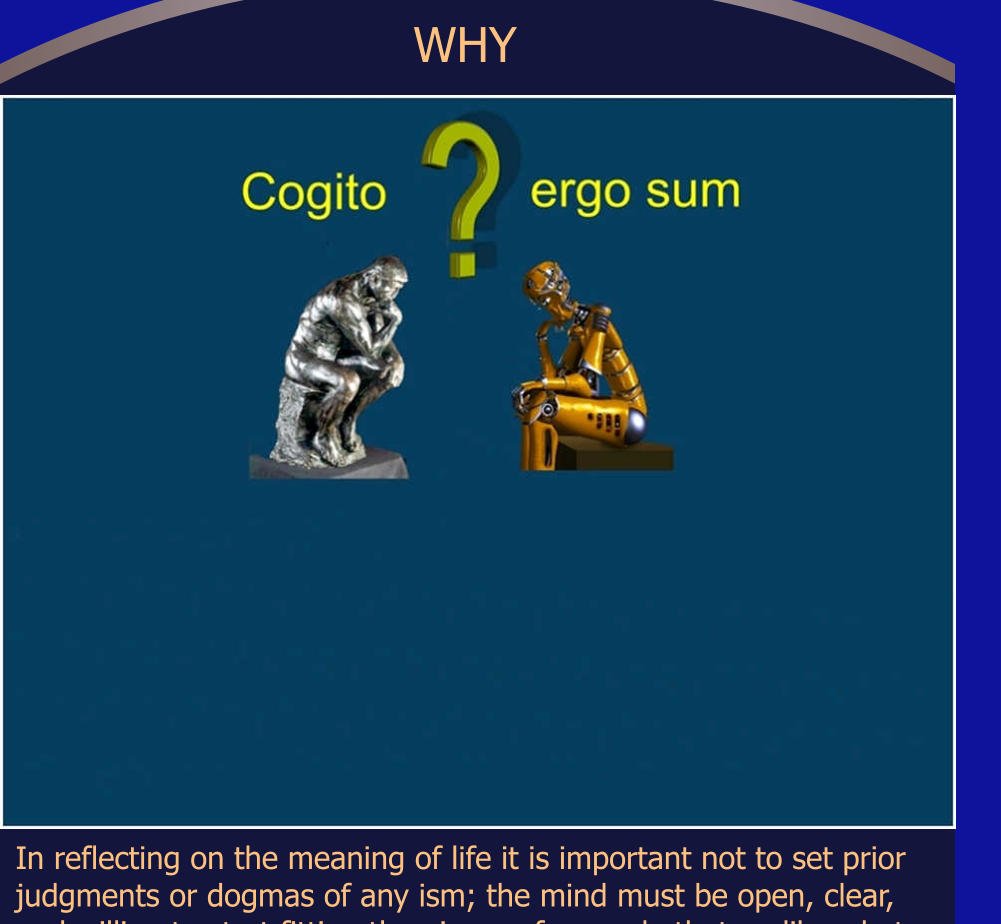
In Cartesian dualism, Descartes conceives two substances that can
exist independently of one another: one is the body and the other
the thinking part, the soul. Plato’s dualism is posited similarly to
Descartes, but with the difference of the immortality of the soul.
Nor does Aristotelian monism describe, in my view, the
composition of being.
Some religions, like Descartes, establish the duality between mind
and soul, attributing to the latter the result of mental activity or of
self-knowledge of existence, and in reality the immortal part of the
being is the spirit.
Here we refer to the body-brain as the material part of being and
subject to the laws of space-time of the universe we live in. The
mind-consciousness would be the result of mental activity and of
the self, which we would call self-knowledge. The soul, the
immaterial and immortal part of being, and the spirit would be the
non-manifested part of the Absolute. Neither Descartes, nor Plato,
nor Aristotle, nor I myself can affirm what the correct conception
is, but it will help us begin to glimpse what the rules of this game
we call life are.

Following
“Perhaps we may never know what our purpose is, but it’s worth trying.”
“There are those who say God did not create the universe. They are right,
since He is the universe itself.”
“Science can answer the question of how, but why belongs to philosophy.”
Albert Einstein stated: “We understand more every day, and we
understand less.”

RVM