

Following

If in the previous chapter we had enough references to
establish a line of research that would serve us for
hypothetical theories, here the material is not exactly the
most abundant, and it is not easy to separate the wheat from
the chaff. We have phenomena such as precognitive dreams,
deja vu, prophecy, precognition, etc. Science most of the
time classifies them as a possible neurological deviation or
epilepsy, which is the same as saying that it has no idea why.
On the other hand, we have temporal shifts in space-time,
more or less documented. What we are going to present in
this chapter is nothing more than a theory, which in principle
would cover a possible explanation of how the being moves
through this multidimensional universe in which it has had to
live.
THE BEING

We are dimensional beings, subject to these three
dimensions—height, width, depth—and a fourth: time, which we
cannot even master. This leaves us practically unable to
conceive infinity or absolute nothingness or simply the relativity
of space-time. Because of countless science fiction novels and
films, we begin to believe that it would be possible to travel to
the past to see how the pyramids were built, or to the future to
observe what may come at us. How is it possible to travel to the
past or the future? Perhaps not too orthodox, but let’s make an
analogy with a cinematographic film and its projection camera:
the film would be the line of a person’s life, from birth to death;
the camera lens would be their vital moment—the day-to-day
life they are living; and the spectators watching the screen
would be the audience, the frame that was projected a minute
ago would be the past for the viewer, and the upcoming,
unprojected frames would be the future. With what has been
stated, we aim to explain that what we call life has no time; we
impose it. the past, present, and future occur simultaneously.
Nero burns Rome, which would be the past for our time; he
invents clean energy, which would be the future according to
our time; all exists at the same time, and we activate it when,
with our time, we make it present.
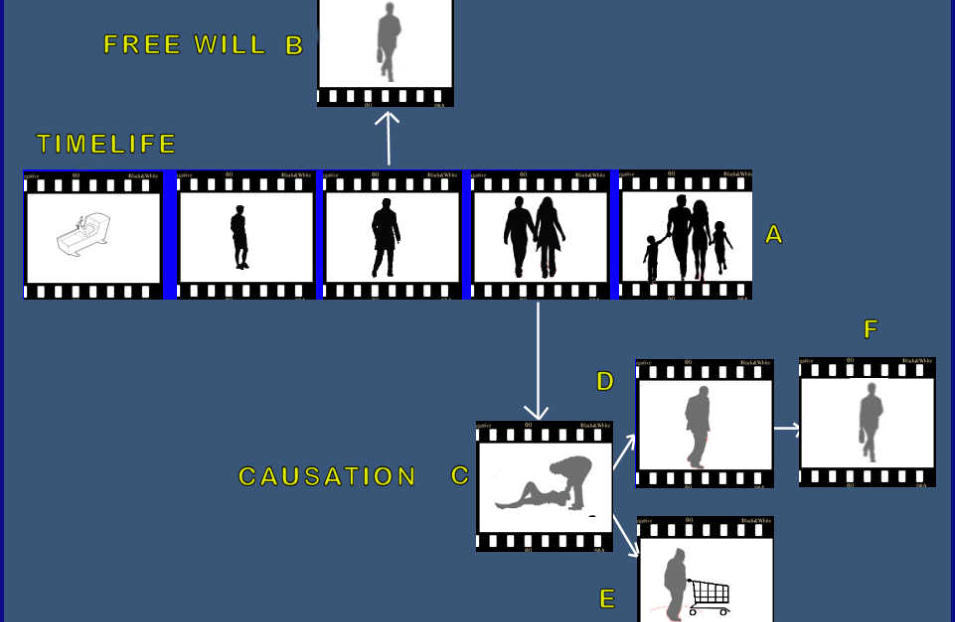
If we continue with the cinematographic analogy, in this diagram
we see how a soul incarnates in a physical body prepared to live
a life cycle. Here, unlike a movie, there can be many and very
diverse endings. As we have seen before, we have free will,
which must help us achieve our final objective. In box B, the
being freely chooses not to start a family and to dedicate itself to
an activity that it believes can help it achieve this objective more
effectively. In diagram C, a causality occurs—an unforeseen
event—that can completely alter its final destiny: it loses the
partner with whom it intended to start a family. This event can
produce several outcomes: D, that it manages to recover and
decides not to form a family, ending what had previously been an
aspiration and had been set aside; or as we see in box E, it does
not recover and ends up losing all interest in life. And as we will
see in the next diagram, a soul may need to use several bodies
and life cycles to fulfill its objective and finally return to the
abode assigned to it in the Absolute, depending on the result in
its one or more personifications.

Previous

RVM