

As we have seen before, an electron is a photon that has lost energy
and gained mass; therefore, this movement or flow of electrons
generates what we call electric current, and by the same law it
generates a magnetic field around it.
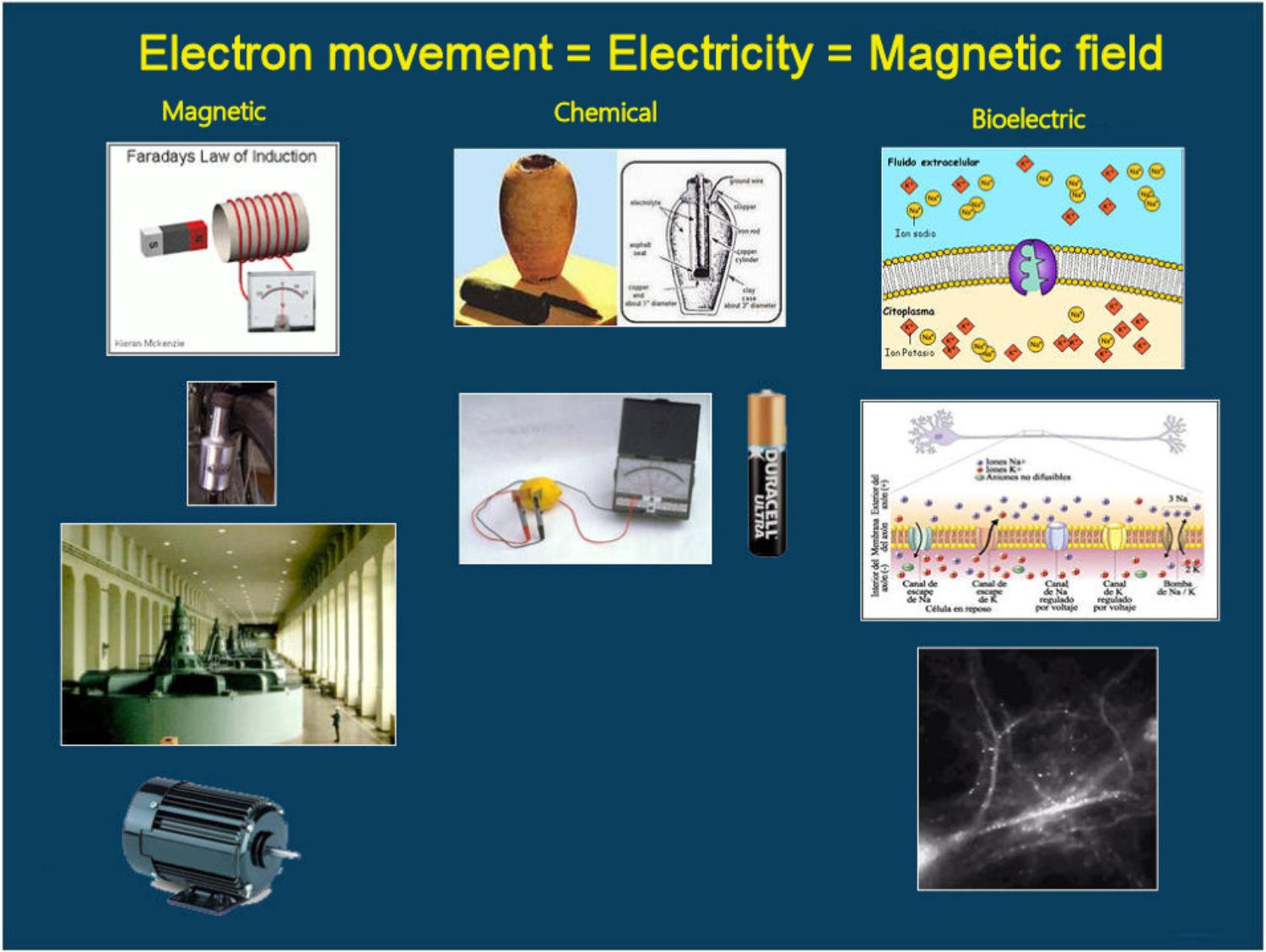
If we look at the drawing, we can appreciate that the magnetic field
of the magnet moves the electrons in the wire, i.e., it produces
electricity. This is the principle of the well-known dynamo, like those
in bicycles or large generators driven by water turbines, and
conversely, if we circulate an electric current through a wire (in a
coil form to achieve a significant increase in this magnetic field), we
will obtain the movement of the magnet, i.e., the well-known motor.
Another system to produce electricity is the chemical process, such
as the Baghdad Battery known from over 2000 years ago (its
original use is not well understood), or what we can experiment
ourselves with a sheet of copper and another of zinc inserted into a
lemon, or into any acidic medium, and measuring with a voltmeter
we can appreciate the flow of a small electric current; in this case
the moving particles are the ions (positively or negatively charged
atoms). And finally, we ourselves generate our own
bioelectromagnetic electricity, due to the exchange of ions of
different potentials; in the attached drawing we can see the passage
of an electric current through the axon of a neuron, which in turn
produces a magnetic field around it.


THE THEORIES
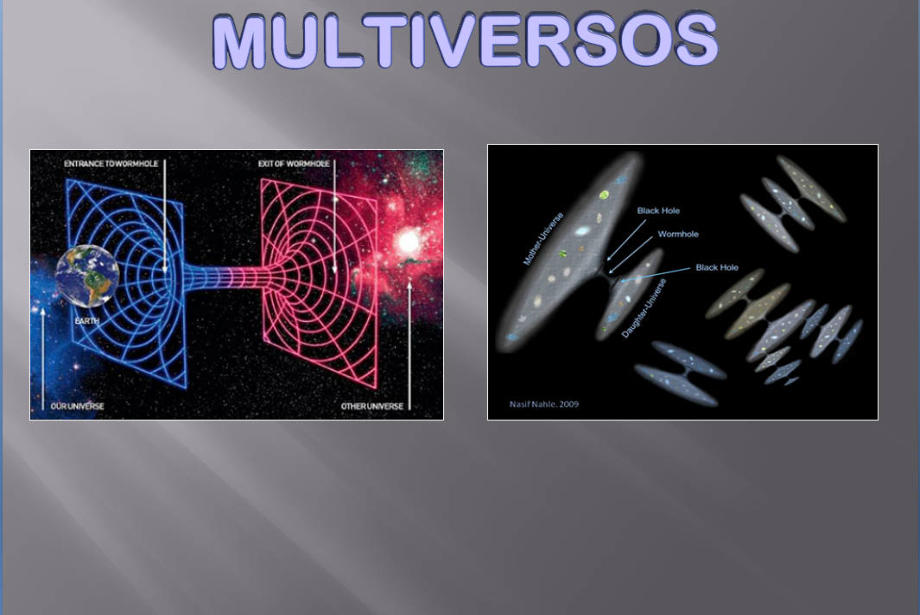
Here we observe an interesting theory: The Multiverses.
It is based on the idea that every black hole, named so for the
immense gravity it generates, absorbs all the matter within its
reach, including light photons.
The immense energy it absorbs is discharged at the opposite
end, thus generating a new Big Bang — that is, a new universe
for each black hole, and so on indefinitely.
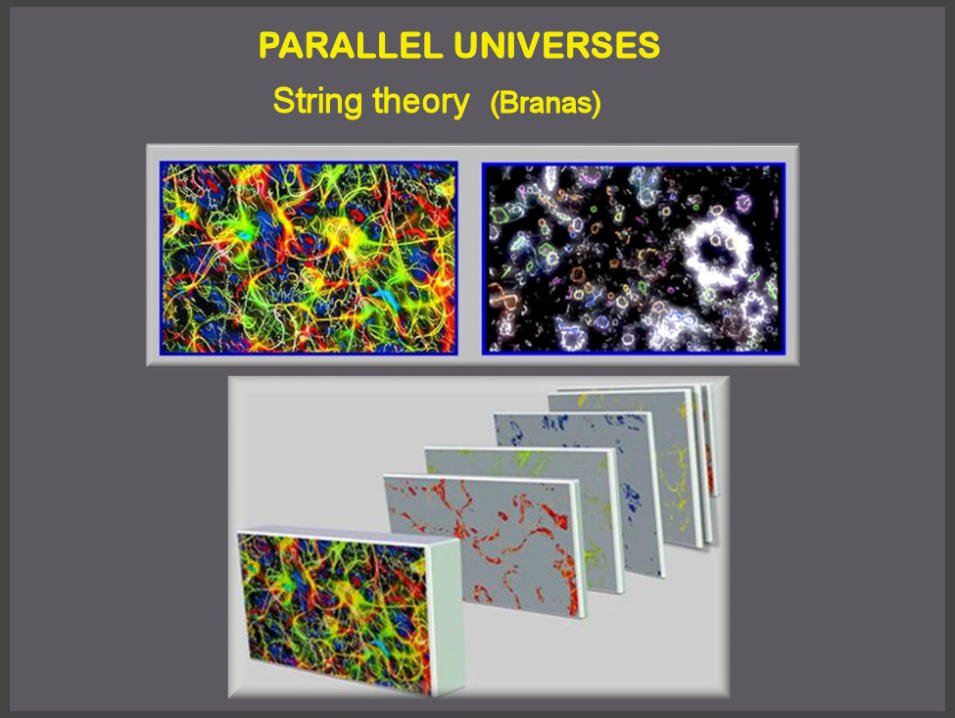
This theory refers to the idea that the universe is formed by
pure energy charges without mass called quantums. Their form
is like a small filament or string, which physics calls branes.
These filaments, like all energy, are in constant vibration, but
with a particularity according to their length or electrical charge
(quantums): they vibrate at different frequencies. We could
make a similarity with a large square where several people talk
on their mobile phones, without interference between them
because each phone is on a different frequency. If we imagine
the square as a cosmos and the frequencies of each mobile
phone as the filaments or quantums, each of these frequencies
would be a universe recognizable by each of us who are on the
same frequency; simply varying this frequency would let us pass
from one universe to another. Obviously this is just a theory and
not so simple, but it explains one of the possibilities of how
universes could be formed within a whole as shown in the
attached drawing.

RVM
Following
Previous