
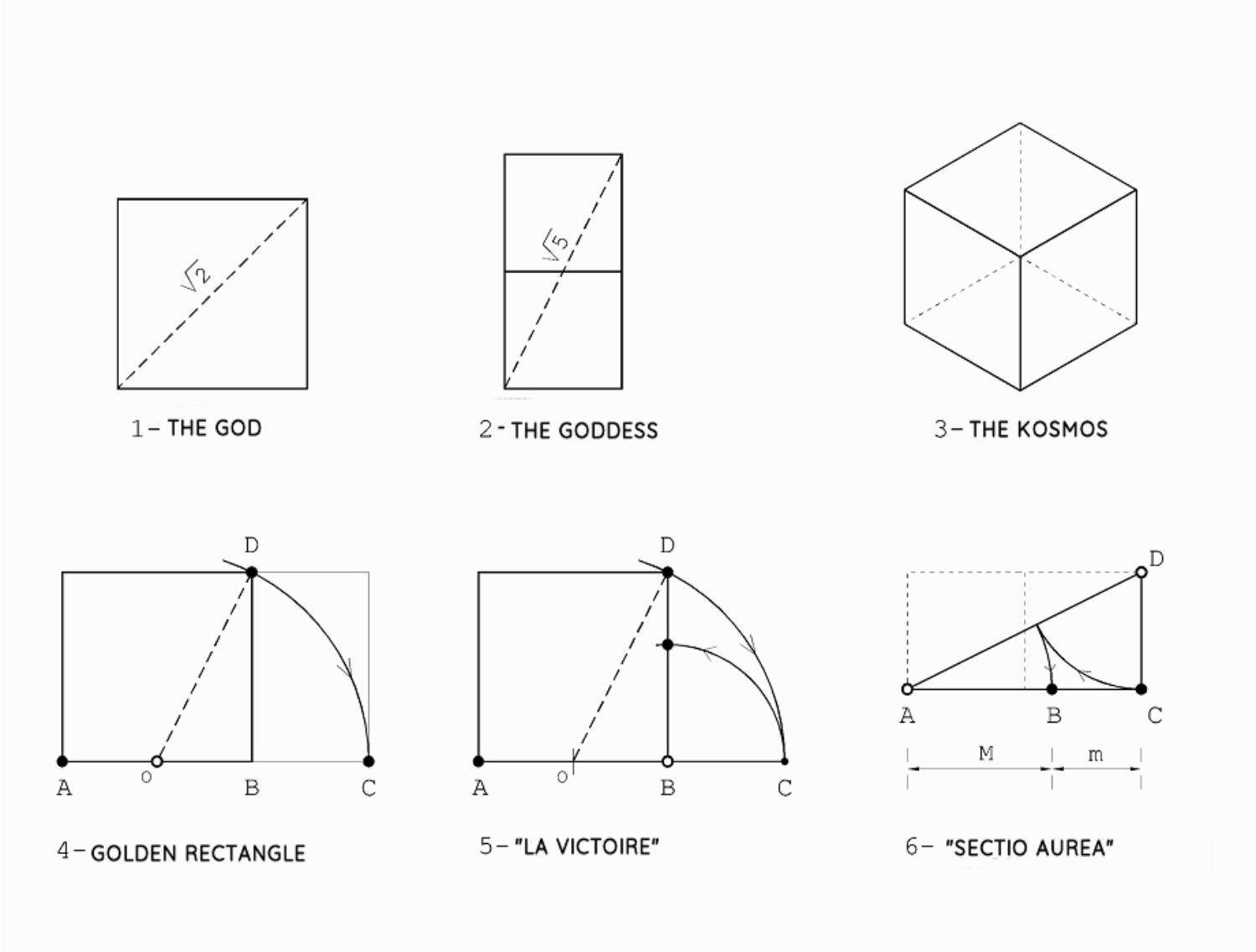
Fig.
2:
Fig.
2:
The
generation
of
the
Golden
Number.
We
can
observe
how,
by
means
of
the
square,
the
form
and
harmony
of
all
the
mathematical
derivations
contained
in
this
figure,
symbol
of
matter,
are
generated. © Josep Gonzàlez
But
what
is
the
golden
number?
What
does
it
contribute
to
the
beauty
of
things,
to
their
form
and
growth,
and
to
the
organization of their internal structure?
We
could
describe
it
as
Euclid
did:
division
in
“Extreme
and
Mean
Ratio”
(Elements,
Book
VI,
def.
3):
“A
straight
line
is
said
to
have
been
cut
in
extreme
and
mean
ratio
when
the
[whole]
line
is
to
the
greater
segment
as
the
greater
segment
is
to
the
lesser”
(Fig.
2).
This
relation
between
segments
occurs
with
such
similarity
and
versatility
in
its
growth
that
it
is
able
to
create
the
family
of
the
five
bodies
or
“Platonic
solids”,
regular
polyhedra
constructed
and
analyzed
by
Theaetetus
and
with
which
Plato
studied
the
origin
and
structure
of
the
universe.
They
combined
Empedocles’
idea
of
the
existence
of
four
basic
elements
constituting
matter
with
Democritus’
atomic
theory.
And
the
fundamental
key
by
which
it
is
possible
to
unite
them
is
the
quintessence,
which
the
Pythagoreans
symbolized
with
the
five-
pointed
star,
a
polyhedral
figure
impossible
to
draw
if
the
“Golden”
division
is
unknown.
And
it
is
precisely
this
pentalpha
star
that
the
Pythagorean
fraternity
used
as
a
sign
of
recognition,
tracing
it
in
the
manner
of
the
master,
such
that
violation
of
the
supreme
secret,
the
golden
key,
meant
a
death
sentence
for
the
informer.
The
five
pre-Socratic
elements
of
creation:
earth,
water,
air,
fire
and
the
aether
or
universe,
were
represented
by
the
five
Platonic
solids.
Cube,
tetrahedron,
octahedron,
icosahedron
and
dodecahedron,
and
their
Pythagorean
equivalents
Gaia,
Heile,
Aer,
Hudor
and
Hieron
(Hyle),
were
generated
geometrically
by
inclusion
and
consecutive
tangency
of
each
in
the
next,
with
the
“Extreme
and
Mean
Ratio”
appearing
as
the
key
to
this
continuous
spatial
transformation
among
those
regular
polyhedra.
This
secret
key
would
be
inherited
by
all
the
initiatory
groups
derived
from
Pythagoreanism
and
Orphism,
being
kept
secret
(Fig.
3)
from
adept
to
adept,
or,
as
R.
Ambelain
would
say,
from
epopt
to
epopt,
until
at
the
dawn
of
the
Renaissance
it
came
to
be
revealed.
Its
geometric
formula
was
remembered
as
the
“figure
de
la
Victoire”
by
Philippe
Eléphant,
a
14th-century
sage
from
Toulouse
who
wrote
on
Euclid’s
Elementa.
Victory:
one
of
the
key
names
by
which
operative
masonry
and
the
compagnonnage
concealed the generating construction of the divine proportion.
.

RVM


PREVIOUS FOLLOWING
















DIVINE ARCHITECTURE