

We
do
not
know
what
or
who
they
are,
but
we
do
know
that
they
have
stimulated
the
imagination
of
people
of
all
ages
and
cultures.
R.
De
Vaux
states
that
the
Assyrian
protective
entities
Karabu,
(who
guarded
the
entrance
to
the
holy
places),
were
the
ancestors
of
the
biblical
Cherubim.
The
Persian
mystic
Zaratrusta
(628-551
BC)
saw
the
world
as
a
battleground
between
good
and
evil,
describing
light
as
a
beneficent
manifestation
of
divinity,
darkness
inherent
in
evil,
and
the
two permanently at odds.
The
study
of
Angelology
seems
to
belong
more
to
theology
than
to
symbolism,
although
the
latter
has
always
tried
to
represent
in
one
way
or
another
this
dual
universe
in
which
we
live,
light
vs.
darkness,
good
vs.
evil,
salvation
vs.
damnation,
virtue vs. vice.
All
and
more
of
these
dichotomies
are
given
to
us
by
observation
of
the
natural
world
and
our
own
nature,
where
each
principle
has
another
that
opposes
it.
We
always
try
to
give
form
and
if
possible
anthropomorphic
form
to
what
is
intelligible
to
us.
In
this
context
the
Pseudo
Dionysius
Areopagite
(V
and
VI
AD),
describes
in
great
detail
all
the
heavenly
hierarchies.
In
the
Baroque
period
Italian
artists
introduced
putti
(children) with wings representing innocence and purity.
A
very
well-known
putto
was
Cupid,
alluding
to
love,
or
in
the
Memento
Mori
where
a
putto
places
a
laurel
wreath
on
a
skull,
signifying
the
beginning
and
end
of
life.
It
was
not
until
the
19th
century
that
the
figure
of
the
Guardian
Angel
began
to
be
depicted,
giving
life
to
many
illustrations
aimed
at
the
very
young,
particularly
in
the
20th
century
by
Joan Ferràndiz.
But
everything
has
its
counterpart,
and
we
find
it
in
the
fallen
angels,
in
this
subject
the
most
explicit
allusion
that
the
Bible
makes
in
Revelation
12.7,
and
in
a
more
ambiguous
way
in
Genesis
6.2,
where
it
makes
a
reference
to
their
concupiscence
with
human
women.
There
are
authors
who
refer
to
the
book
of
Enoch
in
the
Ethiopic
version,
where
it
describes
in
more
detail
the
role
that
these
angels
had
in
the
transmission
to
humans
of
the
secrets
of
metallurgy,
horticulture,
and
astrology,
then
God
sent
his
guardian
angels
to
punish
these
angels,
who
by
their
actions
helped
man
out
of
ignorance
and
slavery.
If
we
look
at
the
way
these
guardian
angels
act
in
their
almost
military
attire,
they
show a way of acting that is too human and not angelic enough.
The
fallen
angel
has
become
the
representation
par
excellence
of
man's
condemnation.
These
devils
are
represented
in
such
a
way
that
their
contemplation
is
most
repulsive
to
us.
Jung
describes
angels
and
demons
as
the
archetype
of
good
and
evil
that
lies
in
the
collective
unconscious
of mankind.
Evil
is
not
the
absence
of
good,
it
is
in
itself
a
reality
with
all
its
potency,
it
is
intrinsic
to
the
human
being
that
leads
to
a
destruction
of
others
and
of
oneself.
Good
and
evil
are
in
ourselves,
and
it
is
our
battle
and
our
free
will
that
must
lead
us
towards
the
evolution
or
involution
of
all
humanity,
for
on
the
day
of
judgement
it
is
not
the
individual
person
but
all humanity that will be judged.
ANGELS AND DEMONS






































































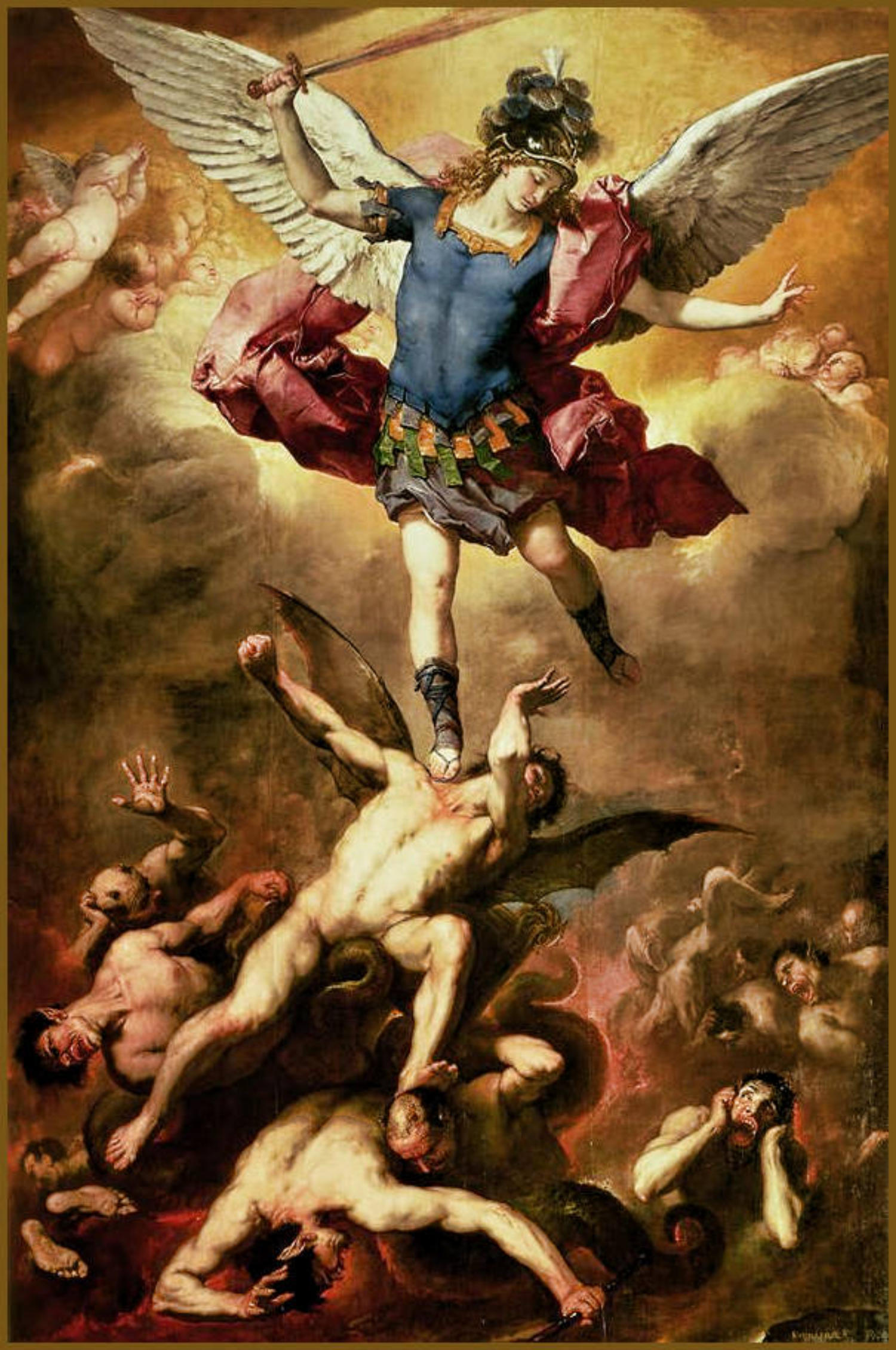
Luca
Giordano

RVM