
This
game
that
we
have
all
played
at
one
time
or
another,
has
always
been
an
entertainment,
although
not
always
childish,
because
its
scope
is much higher than it appears.
There
is
documented
evidence
from
the
late
16th
century,
although
its
origin
is
older;
some
authors
say
that
it
was
the
Templars
who
introduced
the
game
to
Europe,
when
it
was
already
popular
in
Greece,
based
on
the
discovery
of
the
disc
of
Phaistos
in
1908
in
the
palace
of
Crete
with
an
antiquity
of
1,600
years
BC,
and
although
similar
in
appearance,
its
origin
does
not
seem
probable.
Fulcanelli
considered
the
game
of
the
goose
to
be
a
popular
sacred
art.
The
discussion
of
what
the
symbolism
of
the
game
suggests
will
never
end.
It
has
been
said
that
the
game
symbolizes
the
soul
towards
its
access
to
paradise,
but
as
any
good
symbol
does
not
define
it,
only
suggests.
It
could
be
a
guide
to
the
Camino
de
Santiago,
or
the
expansion
of
Catharism
from
French
Languedoc.
On
the
map
of
northern
Spain,
we
find
places
such
as
Nanclares
de
Oca,
Valles
de
Oca,
Villafranca
de
la
Oca,
Montes
de
Oca,
or
the
place
names
derived
from
the
Greek
and
Latin
Anser
(Oca)
Ançares,
Anson,
etc.
The
goose
is
an
iconographic
element
of
a
Gnostic
character,
represented
in
ancient
Egypt
by
the
god
Geb,
it
was
considered
a
symbol
of
the
transmigration
of
the
soul
to
the
afterlife,
a
messenger between earth and heaven.
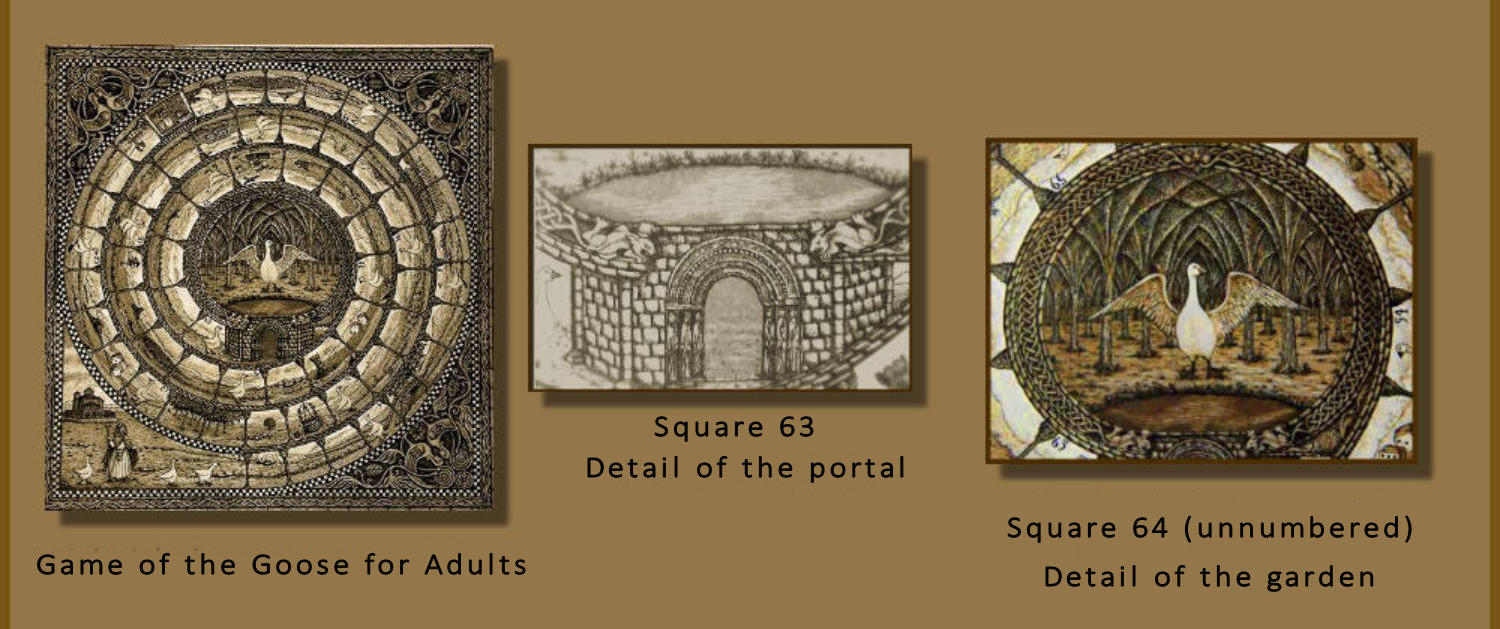
In
the
game
the
squares
are
arranged
in
a
spiral,
the
basic
symbol
of
all
Cosmogony
and
with
seven
consecutive
segments
each
consisting
of
nine
cells,
making
a
total
of
63,
usual
arrangement
in
Rosicrucian
symbolism,
box
64
and
last
unnumbered
represents
the
garden
of
Eden,
in
numerical
symbolism
6
+
4
=
10
symbol
of
the
Unity
from
where
all
the
manifested
world
is
born.
It
is
a
trip
of
the
outside
of
the
manifested
and
temporary
world,
to
the
no
manifested
and
timeless
where
the
goose
has
led
us.
The
squares
symbolize
the
process
that
the
being
must
carry
out
until
reaching
the
final
stage
of
life
and
achieving
salvation,
during
which
he
must
eliminate
the
imperfections
represented
by
the
various
grotesque
figures
in
the
squares.
The
inflection
points
are
seven.
The
bridge,
representing
the
approach
of
the
trip
the
first
step
and
symbol
of
the
transit.
The
hostel,
the
time
we
all
need
to
think.
The
well,
the
deadly
sins
to
be
overcome.
The
labyrinth,
representing
how
easy
it
is
to
lose
the
path
of
search
and
the
utility
of
intuition.
Prison,
when
you
are
a
prisoner
of
yourself
and
your
dogmas.
Finally,
the
box
58,
the
death,
we
all
die
but
it
has
to
be
overcome,
otherwise
you
are
forced
to
start
again,
as
we
are
given
another
chance.
The
first
games
were
intended
for
an
adult
audience
and
it
was
not
until
the
end
of
the
19th
century
that
it
began
to
be
made
for
children,
infantilizing
the
drawings
and thus losing the very intention for which the game was created.
THE GAME OF THE GOOSE







































































RVM