

Who
hasn't
got
lost
walking
through
a
garden
labyrinth?
But
it
has
not
always
been
like
this,
over
time
the
labyrinths
have
changed,
not
so
much
in
their
forms
as
in
their
meaning,
from
those
that
decorate
the
Gothic
cathedrals
of
France,
which
symbolise
the
different
steps
that
the
Christian
must
take
for
his
salvation,
to
those
that
decorate
the
gardens
of the Renaissance, more related to love games than to divinity.
Although
there
are
references
of
labyrinths
from
Egypt
to
ancient
Mesopotamia,
where
it
took
shape
is
in
Greek
mythology,
and
especially
the
Minoan
culture
of
Crete
2800/1200
BC,
and
the
Romans
who
drank
so
much
from
Greek
culture,
spread
it
throughout
the
Christian
world.
We
find
it
both
in
the
courtyards
of
Roman
villas
and
on
the
floors
of
Gothic
cathedrals,
generally
populated
by
frightening
creatures
and
monsters
such
as
the
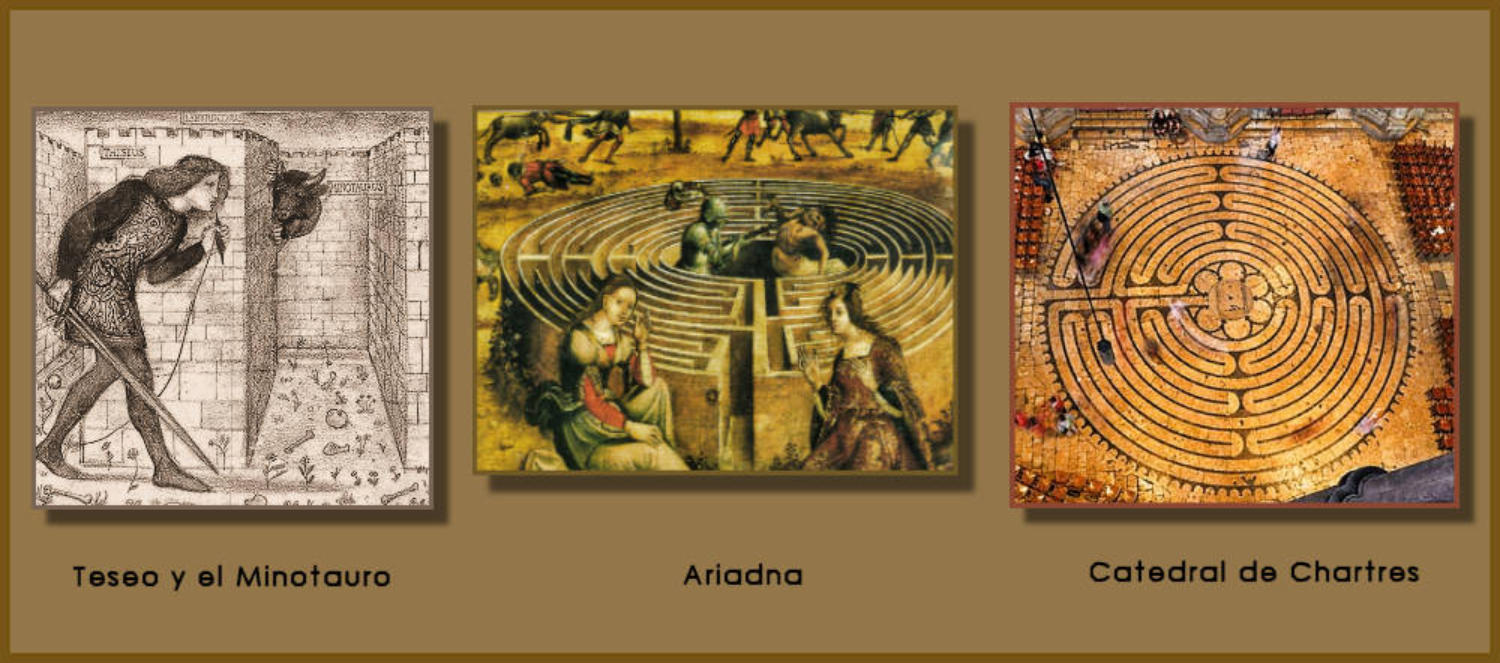
Minotaur,
with
the
body
of
a
man
and
the
head
of
a bull.
The
Greek
myth
of
the
labyrinth
has
been
explained
in
various
ways,
but
essentially
and
briefly
it
is
as
follows:
Parsifae,
wife
of
King
Minos
of
Crete,
as
a
result
of
a
zoophilic
affair,
gave
birth
to
a
being
with
the
body
of a man and the head of a bull.
King
Minos
did
not
dare
to
kill
him,
thinking
that
he
might
be
the
son
of
a
god,
and
asked
Daedalus
to
build
a
labyrinth,
so
that
Asterion
(later
known
as
Minotaur,
the
bull
of
Minos)
could
never
come
out.
Every
nine
years
and
as
an
offering
they
brought
several
young
men
into
the
labyrinth
to
please
the
Monster.
Among
these
young
men
was
Theseus,
who
was
in
love
with
Ariadne
(usually
translated
as
"the
much
revered"),
one
of
the
daughters
of
King
Minos.
Theseus
was
determined
to
kill
the
Monster,
which
he
succeeded
in
doing,
but
the
real
difficulty
lay
in
getting
out
of
the
labyrinth.
Ariadne
gets
Daedalus
to
tell
her
how
to
get
out
and
Daedalus
gives
her
a
ball
of
thread
to
give
to
Theseus,
so
that
she
could
develop
it
when
he
entered
the
labyrinth,
thus
guiding
him
on
his
return
(although
nowadays
when
a
person
has
to
get
out
of
a
complicated matter, they are told that they need a thread from Ariadne).
In
the
11th
century
labyrinths
entered
churches.
The
best
known
is
on
the
floor
of
Chartres
Cathedral
in
France,
in
the
centre
of
which
was
a
bronze
plaque
depicting
Theseus'
struggle
with
the
Minotaur;
it
was
destroyed
in
the
18th
century
during
the
French
Revolution,
probably
to
make
cannons.
Some
authors
support
that
the
labyrinths
of
the
cathedrals
served
during
the
Middle
Ages
as
a
substitute
ritual
for
the
pilgrimage
to
both
Jerusalem
and
Santiago,
both
for
those
in
poor
health
and
for
penitents.
It
was
not
until
the
Renaissance
that
labyrinths
were
merged with gardens.
If
during
the
Middle
Ages
the
mythological
legacy
survived
disguised
as
Christian
allegories,
during
the
Renaissance
its
classical
Greco-Roman
legacy
was
recovered,
giving
it
a
more
playful
character
and
more
suitable
for
the
amorous
games
to
which
they
were
so
fond
during
that
period.
The
last
remaining
labyrinth
from
18th
century
Spain
is
the
Horta
labyrinth
in
Barcelona,
built
by
the
Marquis
Joan
Antoni
Desvalls,
a
mathematician
and
physicist.
In
the
centre
of
the
labyrinth
there
is
a
statue of Eros, and on the side a small temple dedicated to Ariadne.
THE LABYRINTHS AND ARIADNE´S THREAD







































































RVM