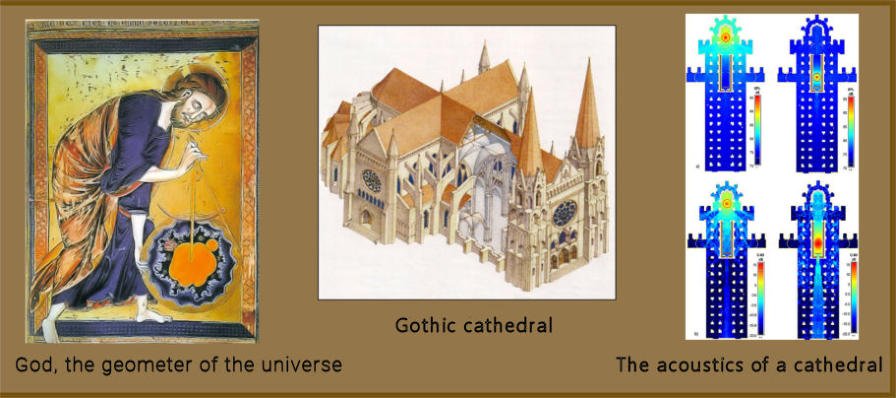

In
ancient
times,
geometry
was
considered
a
sacred
art.
In
ancient
Egypt
they
already
demonstrated
a
truly
elevated
knowledge
of
an
entire
numerical
system
to
describe
the
relationship
between
Earth
and
the
universe,
deducing
that
only
a
superior
intelligence
could
be
the
author
of
its
creation.
This
gave
rise
to
a
series
of
beliefs
and
monotheistic
religions
that
regarded
God
as
the
Great
Geometer
of
the
Universe.
Therefore,
through
architecture,
man
has
sought
to
elevate
himself
and
draw
nearer
to
his
creator,
building
temples
that
attempt
to
reproduce
an
image
of
this
universe,
such
as
cathedrals,
where
everything
from
the
earth
and
the
sun
to
animals,
plants,
crafts,
and
human
wisdom,
natural
history,
and
the
sacred are represented.
These
buildings
were
true
visual
encyclopedias,
very
different
from
some
current
constructions
that
reflect
a
very
personal
vision
of
the
architect.
All
this
building
system
is
nothing
more
than
an
attempt
to
explain
the
invisible
through the visible.
Construction
began
with
the
orientation
of
the
temple
by
a
method
described
by
Vitruvius,
where
a
stake
was
placed
at
the
center
of
a
circle
and
the
maximum
separation
of
the
morning
and
afternoon
shadows
marked
the
east-west
axis.
Two
circles
centered
on
the
cardinal
points
marked
the
intersection
of
the
angles
of
the
square,
calling
this
operation
the
squaring
of
the
circle,
and
from
this
the
building
was
projected.
These
two
figures,
the
square
and
the
circle,
are
the
primordial
symbols
of
divine
perfection,
due
to
the
relationship
of
the
circle
with
the
sphere
in
which
all
points
are
equidistant,
representing
the
unity
and
perfection
of
God.
The
square
with
the
cube
is
the
image
of
immutability,
of
creation
in
the
three-dimensional
space.
This
relation
between
the
sphere
and
the
cube
is
the
foundation
on
which
temples
are
built.
If
we
move
from
the
horizontal
plane
to
the
vertical,
i.e.,
from
flat
geometry
to
space
geometry,
we
will
see
that
the
entire
building
is
reduced
to
the
scheme
of
the
sphere
or
hemisphere
in
the
dome,
and
the
cubes
forming
the
cross
ultimately
give
the
building
its
shape;
if
we
draw
a
vertical
line
from
the
central
cube
to
the
dome,
we
have
the
passage
from
the
earthly
(the
cube)
to
the
celestial
(the
hemisphere).
This
internal
dynamism
of
the
temple
serves
as
the
basis
for
the
elevation
of
consciousness.
Plato,
in
the
Timeaus
dialogue
and
referring
to
the
Pythagorean
school,
already
spoke
of
the
relation
of
God
with
geometry,
mathematics,
and
music,
as
the
Great
Architect
of
the
Universe.
Augustine,
in
his
treatise
on
music,
expounds
the
theory
that
music
and
architecture
are
sisters,
daughters
of
number
and
eternal
harmony;
medieval
builders
already
knew
the
analogy
between
architectural
proportions
and
musical
intervals,
they
used
the
number
called
the
golden
ratio
1.618
=
Phi,
also
known
as
the
divine or golden proportion, which is a constant in all created beings.






































































HOLY GEOMETRY

RVM