
The
circle
is
one
of
the
most
elementary
symbols
and,
precisely
because
of its simplicity, one of the most complex and plural.
As
the
basis
of
many
other
symbols,
it
requires
a
good
understanding;
otherwise,
a
large
part
of
the
existing
symbolism
cannot
be
correctly
interpreted.
In
antiquity
Hermes
told
us
that
the
circle
has
its
center
everywhere
and
its circumference nowhere, indicating the omnipresence of the Creator.
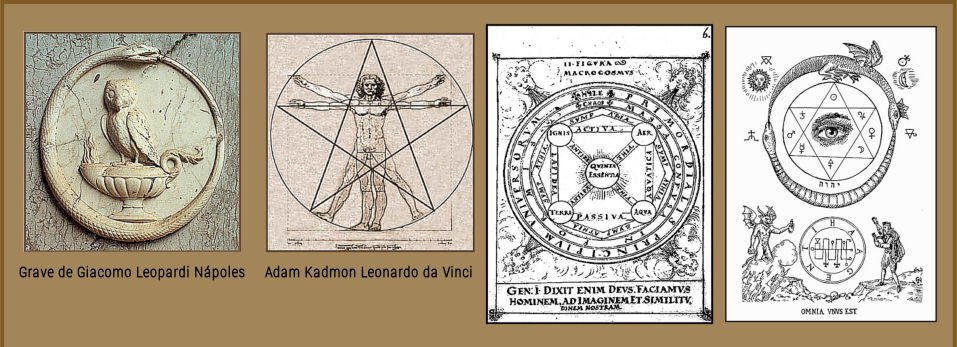
In
Greece
they
represented
this
circle
as
a
serpent
devouring
its
tail.
The
Pythagorean
school
left
us
in
geometry
its
most
famous
theorem.
Likewise,
in
symbolism
it
left
us
a
symbol
known
as
the
Tetraktys.
A
circle
that,
as
a
figure,
has
neither
beginning
nor
end,
symbol
of
the
whole
with
a
central
point
that
indicates
the
first
manifestation
of
the
creation
of
the
physical
world,
from
which
all
subsequent
points
emanate,
thus
defining
the interrelation of spirit and matter.
In
schematic
form,
it
is
represented
as
a
circle
with
a
dot
in
the
middle,
inside
which
is
inscribed
a
square.
It
symbolizes
the
matter
from
which
the
physical
world
is
composed,
represented
by
each
part
of
the
square:
air, water, fire, and earth.
Within
this
quadrature,
a
cross
represents
the
human
being
subject
to
the
physical
part
by
the
four
elements
mentioned,
so
that
at
its
center
we
have the first point of the manifestation of the incarnation of the Word.
The
temples,
in
their
most
symbolic
form,
are
the
result
of
a
quadrature
on
the
cardinal
axes
that
form
the
cross,
all
crowned
by
a
circle
represented
by
the
dome
or
circular
cupola
with
a
central
point
that
is
the
lucerne
(firefly).
The
cabalists
often
represent
it
inversely,
the
circle
inscribed
within
a
square,
wanting
to
symbolize
the
hidden
divinity
in
matter, which animates and gives it life.
The
Babylonians
divided
the
circle
into
360
parts
or
degrees,
grouping
them
into
six
sixty-part
segments,
which
corresponds
to
the
sexagesimal
system still used today.






































































THE CIRCLE

RVM