

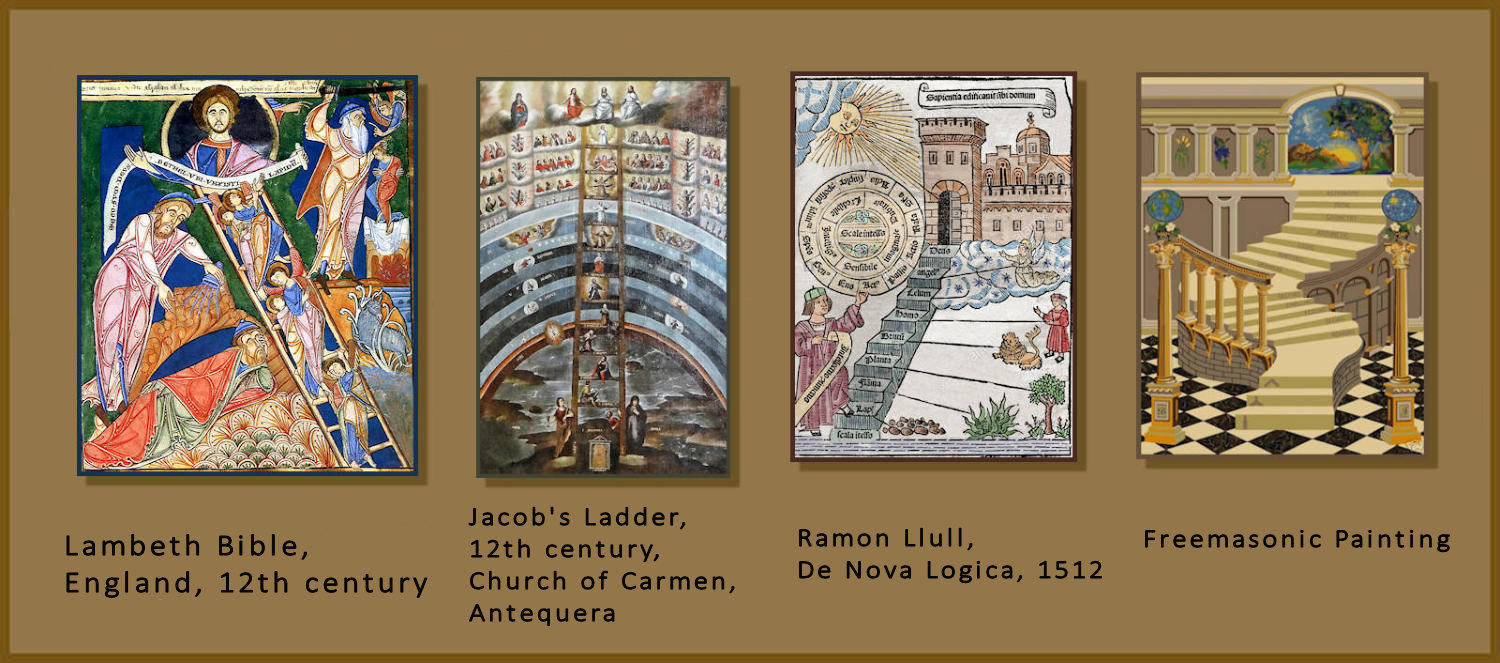
In
Genesis
XXVIII
10-16
Jacob
dreams
of
a
stairway
between
earth
and
heaven
on
which
the
angels
ascend
and
descend,
the
Axis
Mundi
is
a
double
way
by
which
man
aspires
to
unite
with
God
and
God
descends
to seek man.
This
reflects
the
belief
that
in
the
earthly
Paradise
there
was
originally
a
stairway,
which
permanently
communicated
between
man
and
God.
This
communication was interrupted by the expulsion from Paradise.
In
the
course
of
time,
it
has
survived
as
a
symbol
of
the
path
that
man
must
take
to
reach
the
heavenly
kingdom,
the
steps
representing
the
virtues
that
must
be
conquered
one
by
one,
being
rejected
by
a
series
of
demons, as can be seen in the ancient engravings of the Middle Ages.
At
this
time
the
Cistercian
monasteries
were
defined
as
a
stairway
to
heaven
"Scala
Dei"
as
it
was
inside
the
cloister
where
the
monk
could
reach
heaven.
In
Hermetic
symbology,
we
find
references
to
Ramon
Llull,
the
Catalan
philosopher,
describes
in
"De
Nova
Logica"
in
1512,
a
ladder
that
leads
to
Sophia
referring
to
the
knowledge
where
man
with
the help of the Arte Generalis can ascend.
Eckhard,
writes
What
is
higher
in
his
unfathomable
deity
corresponds
to
what is lower in the depth of his humility.
In
Ancient
Egypt
references
to
the
ladder
are
found
in
the
Book
of
the
Dead;
a
ladder
of
nine
steps
called
the
ladder
of
Ra.
From
the
cult
of
Mithras
(1400
B.C.
continued
into
the
17th
century,
both
in
Catharism
and
Manichaeism.
Hence
the
tradition
of
the
seven-step
ladder,
signifying
the
various
degrees
of
spiritual
initiation,
a
meaning
still
valid
today in various rites.
In
the
Middle
Ages
the
Hermetists
represented
this
process
of
inner
growth
with
a
spiral
staircase,
where
this
constant
turning
hides
what
you
will
find
at
the
next
bend,
and
that
to
continue
ascending
requires
courage,
faith,
and
determination.
It
is
the
symbol
of
personal
self-
improvement.
In
15th
and
16th
century
paintings,
the
first
step
is
represented
by
a
dragon
signifying
sin
and
must
be
stepped
on
in
order
to
start
ascending,
the
staircase
can
also
be
represented
descending
where
each
step
is
a
vice,
leading
us
to
the
realm
of
the
fallen,
or
to
the
unconscious
introspection
of
the
unconscious.
It
seems
that
the
universality
of
this
symbol
is
the
perpetual
yearning
of
the
human
being,
which
draws
him
imperiously
to
be
one
with
the
One.
Axó
always
brings
us
to
the
same
dilemma: the relationship between Man and God or Heaven and Earth.






































































THE LADDER

RVM