

This
symbol
is
a
clear
example
of
the
symbol
called
compound,
with
a
double
allegorical
and
hermetic
interpretation.
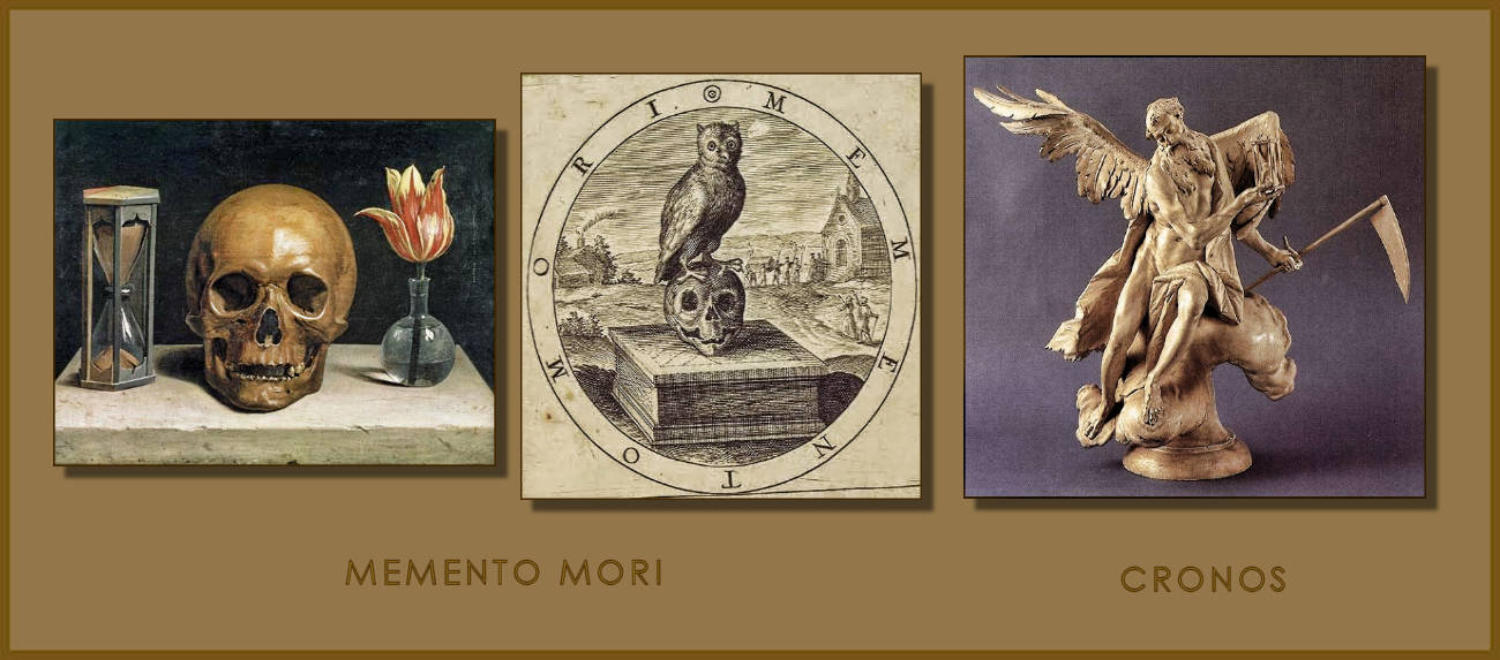
Traditionally
the
hourglass
has been accepted as an allegory of the passage of time.
When
it’s
depicted
with
wings
and
a
scythe
or
skull
it
wants
to
symbolize
the
brevity
of
human
life.
The
grains
of
sand
fall
slowly
but
steadily,
and
before
we
know
it
the
bottle
has
emptied.
Let’s
remember
St.
Matthew
(XXV:
V
13)
"Watch,
because
you
know
neither
the
day
nor
the
hour",
or
the
song
of
the
Psalm
(LXXXIX:
V
49)
"What
man
will
live
and
not
see
death?".
In
the
hermetic
interpretation,
we
can
suggest
that
the
hourglass
by
turning
on
itself,
indicates
to
us
the
possibility
of
the
return
to
the
origins.
This
symmetrical
shape
of
the
bottle,
with
its
double
compartment,
shows
us
the
principle
of
correspondence.
This
principle
announced
by
Hermes
Trimegist,
a
Greek
name,
means
Hermes
the
Three
Times
Great,
and
his
identity
reaches
the
origins
of
pre-Pharaonic
Egypt.
Other
interpretations
argue
that
Hermes
was
not
an
individual
personality,
but
a
set
of
teachings
elaborated
in
the
Hellenistic
world.
Plutarch
believes
that
Hermes,
was
the
first
in
ancient
Egypt,
who
knew
the
writing
of
the
gods,
which
more
than
writing
were
signs,
and
knowing
these
signs
and
their
correct
pronunciation,
was
a
decisive
action.
This
principle
of
correspondence,
the
second
of
its
seven
principles,
comes
to
say:
"How
it
is
above
is
below,
and
how
it
is
below
is
above,"
and
thus
describes
a
holistic
model
of
the
entire
created
universe.
Similar
is
the
movement
of
electrons
orbiting
the
nucleus
of
the
atom,
as
is the movement of planets around the Sun.
The
emptiness
and
fullness
of
this
double
bottle
must
follow
one
another
continuously,
creating
a
current
from
the
upper
to
the
lower,
one
can
say
from
"Heaven"
to
"Earth",
and
by
this
same
principle
of
correspondence,
a
another
reverse
current
from
the
Earthly
to
the
Celestial.
This
would
be
the
image
of
the
hermetic
and
alchemical
interpretation of this symbol.
THE HOURGLASS







































































RVM