

The
ring,
being
a
circle
without
beginning
or
end,
is
a
universal
symbol
of
eternity
and
continuity,
as
a
circle
it
has
a
similarity
with
all
the
bodies
of the created universe, and for this reason it is associated with divinity.
The
act
of
putting
one's
finger
in
the
ring
presupposes
in
itself
the
acceptance
of
the
symbolism
associated
with
it,
which
has
been
adapted
to the conveniences and beliefs of each people and each ideology.
In
Christianity
we
find
its
highest
meaning
in
the
papal
ring
called
the
Fisherman's
Ring,
the
supreme
Roman
Catholic
seal,
destroyed
by
Cardinal
Camerlengo
on
the
death
of
the
POPE
(acronym
of
Petri
Apostoli
Potestades
Accipiens,
although
there
are
contexts
of
Petrus
Augustus Pontifex Augustus).
The
nuns
wear
the
ring
at
their
spiritual
wedding
along
with
the
veil
and
crown;
at
this
time
the
novice
was
recited
a
prayer,
Deus
Plasmator
corporum,
attributed
to
St.
Matthew
(Rene
Metz,
consecration
decembre
Vierges
dans
l'église
romaine),
Accipe
annulum
fidei
.......
Receive
the
ring
of
faith,
sign
of
the
Holy
Spirit,
so
that
you
may
be
acclaimed
bride
of
Christ.
From
this
religious
tradition,
it
was
derived
in
the
Middle
Ages
to put the ring on the bride on the wedding day.
The
Celts
considered
that
it
should
be
of
pure
gold
as
a
symbol
of
the
purity
of
the
bride.
In
ancient
Rome,
citizens
worthy
of
special
recognition
were
given
the
right
to
wear
an
iron
ring,
priests
of
Jupiter
and
senators
wore
it
in
gold,
hence
the
so-called
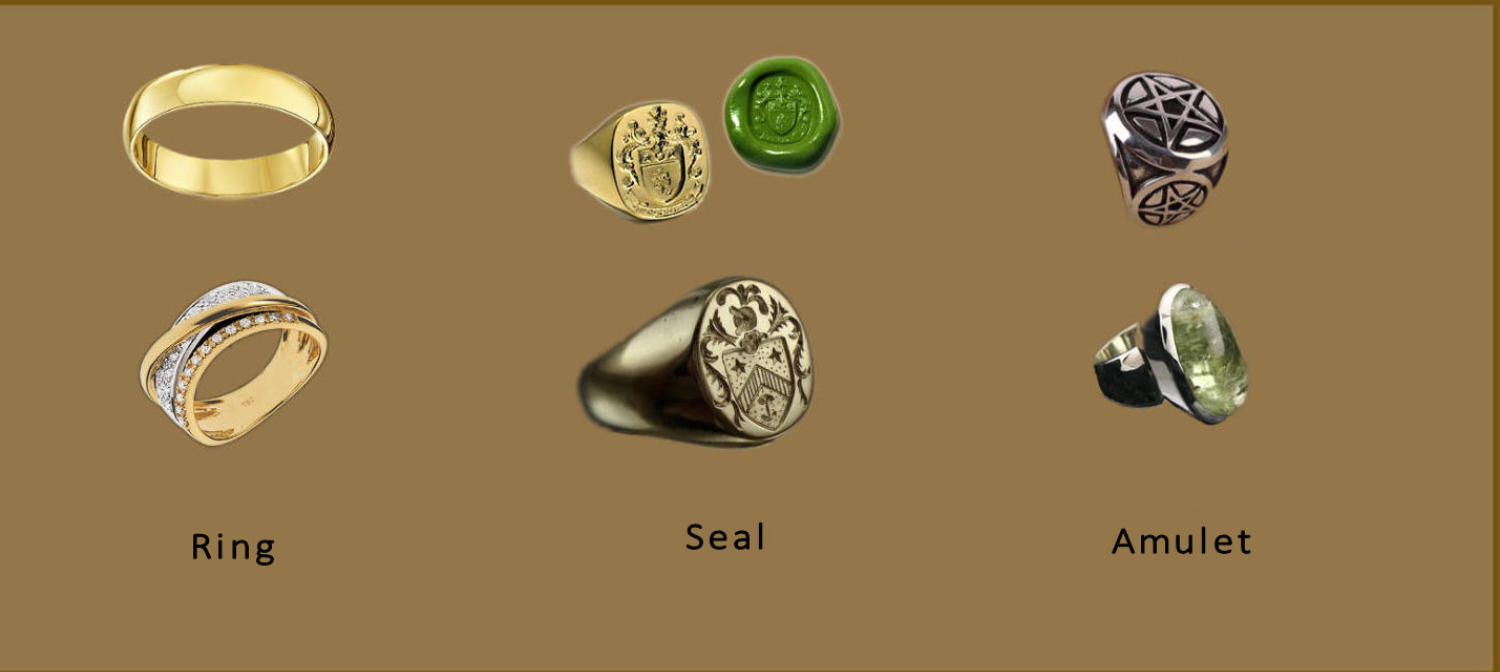
signet
rings,
usually
with
heraldic
symbols
with
the
virtue
of
authenticating
documents,
these
rings used to be hereditary.
In
magical
literature,
rings
called
amulets,
with
healing
or
other
properties,
are
described.
Agrippa
Nettesheim
(1486-1535),
gives
instructions
for
the
elaboration
of
rings
with
precious
stones
with
all
kinds of properties and virtues.
In
Mythology
we
find
several
famous
rings,
Prometheus
freed
by
Herakles
was
obliged
to
wear
an
iron
ring
with
a
piece
of
stone,
in
memory
of
the
rock
where
he
had
been
padlocked
and
as
a
symbol
of
submission
to
Zeus,
the
ring
of
King
Polycrates
of
Samos
to
whom
fortune
was
favourable
until
the
day
he
lost
it,
he
died
crucified
in
522
BC,
and
the
no
less
known
ring
of
Gigas
that
Plato
describes
how
this
shepherd
found
it
(Republic
359)
and
put
it
on
his
finger,
discovering
by
chance
that
when
he
turned
it
became
invisible,
the
basis
of
Tolkien's
famous story "The Lord of the Rings".







































































RVM
THE RING