

The
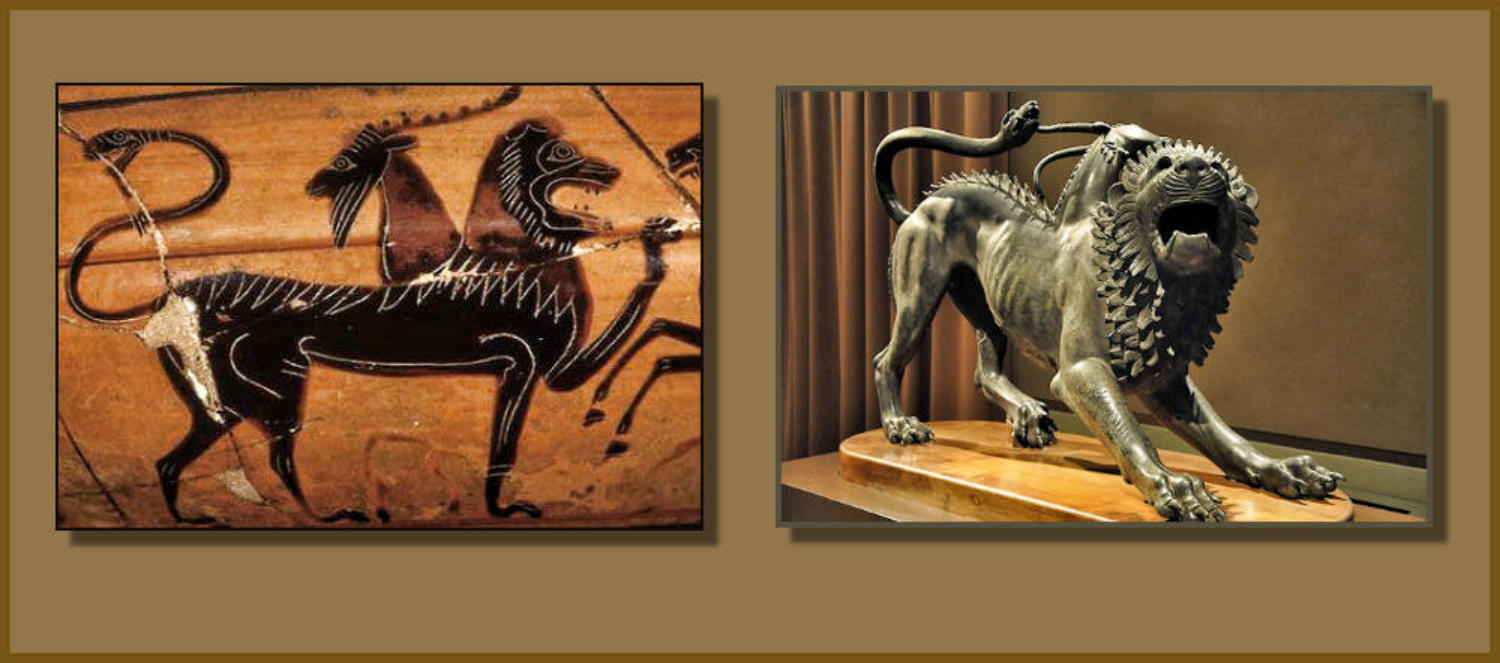
Chimera
refers
to
a
dreadful
being
born
of
Typhon,
a
monster
of
the
underwater
world,
and
of
Echidna,
a
serpent
woman
and
sister
of
the
Gorgons,
described
and
depicted
as
having
the
head
of
a
lion,
the
body
of
a
goat,
and
a
tail
in
the
form
of
a
snake,
sometimes
with
a
dragon's tail and spewing fire from its mouth.
Like
other
teratogenic
beings,
it
is
a
symbol
of
complex
perversion.
In
Greek
mythology,
the
Chimera
was
killed
by
the
hero
Bellerophon,
prince
of
Corinth
riding
the
winged
horse
Pegasus,
provided
to
him
by
the
muses
of
Mount
Hericon,
becoming
the
prototypical
pre-Christian
dragon slayer, like St. George and St. Michael.
This
combat
appears
in
many
works
of
art
and
on
coins
from
Corinth,
where
the
Chimera
was
used
as
a
heraldic
animal.
Analysing
the
symbol,
we
can
see
that
its
meaning
has
evolved,
in
parallel
with
humanity. Originally it represented the elemental tectonic furies.
During
the
Renaissance
it
was
said
of
the
Chimera
that
it
seduced
and
led
astray
the
mind
of
those
who
abandoned
themselves
to
it,
as
it
represented
the
imaginative
and
feverish
creations
of
the
subconscious
and
like
no
other
it
described
the
frustration
of
unfulfilled
desires,
which
are
transformed
into
exasperation
and
pain.
We
see
the
interpretation
given
by
Paul
Diel
in
his
book
"Le
symbolisme
dans
la
Mithologie
grecque",
referring
to
the
Chimera:
it
would
be
a
psychic
deformation,
characterised
by
a
fertile
and
uncontrolled
imagination,
and
which
could
not
represent
more
clearly
the
psychological
reality
of
the
three
forms
of
imaginative
perversion,
the
vanity
symbolised
by
the
serpent,
the
sexual
perversion
symbolised
by
the
goat,
and
the
social
perversion
revealing
the
tendency
to
dominate
represented
by
the
lion.
Nowadays
the
word
chimera
is
used
without
its
symbolic
content,
referring
only
to
a
false
idea
or
illusion
of
an
overflowing
imagination.
Today's
science
also
calls
transgenic
animals,
obtained
by
combining
traits
of
different
species, chimeras.
THE CHIMERA







































































RVM