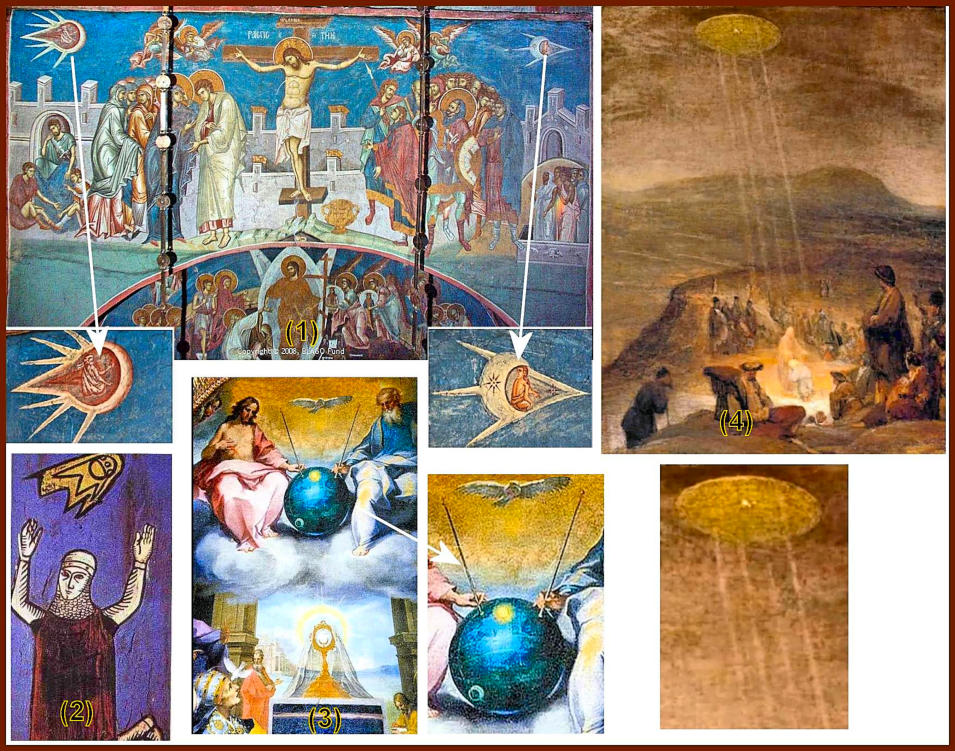

(1)
Fresco
“The
Crucifixion,”
circa
1350
A.D.
In
the
altar
of
Visoki
Decani
Monastery, Yugoslavia.
(2)
“Annales Laurissenses,” manuscript from the 12th century.
(3)
“The
Glorification
of
the
Eucharist”
by
Ventura
Salimbeni
(between
1568
and 1613) in Montalcino, Church of San Pietro.
(4)
The
Baptism
of
Christ
(1710)
by
the
Flemish
painter
Arent
De
Gelder,
Cambridge
Museum
Fitzwilliam.
Here
we
refer
more
to
details
that
are
themselves fully figurative than to symbolism.
Sacred
scriptures
are
filled
with
references
to
lights,
angels,
doves,
stars,
and
other
signs
of
heavenly
origin.
All
this
has
led
painters,
especially
in
the
Middle
Ages,
to
depict
them
in
their
works,
though
sometimes,
as
we
see
in
this
sample,
there
are
interpretations
that
escape
symbolism
and
enter a fully figurative context.
(1)
“The
Crucifixion”
—
we
would
have
some
difficulty
interpreting
as
stars
what
is
described
here
as
flying
objects
with
figures
inside
and
with
an
attitude of manipulating something.
(2)
It
refers
to
an
event
in
the
year
776
during
a
Saxon
siege
at
the
castle
of
Sigiburg,
France,
which
could
be
defined
as
a
comet,
though
chronicles
mention
several
luminous
objects.
Four
centuries
later,
the
illustrator
drew
only one.
(3)
“The
Glorification
of
the
Eucharist,”
we
observe
the
Father
and
the
Son,
and
above
them
the
Holy
Spirit
represented
by
a
dove.
What
is
not
so
easy
for
us
to
interpret
is
the
sphere
they
hold
with
two
rods
like
antennae
and
the protrusion that projects from this sphere.
(4)
“The
Baptism
of
Christ,”
an
object
in
the
shape
of
a
disk
appears
shining
with
rays
of
light
on
John
the
Baptist
and
Jesus,
where
it
would
be
more
logical
to
have
painted
the
Holy
Spirit
in
the
form
of
a
dove,
as
other
artists
have
done,
based
on
the
belief
at
the
time
that
only
birds
had
been
seen flying.







































































RVM
THE SYMBOLISM IN THE PAINTING WORKS