

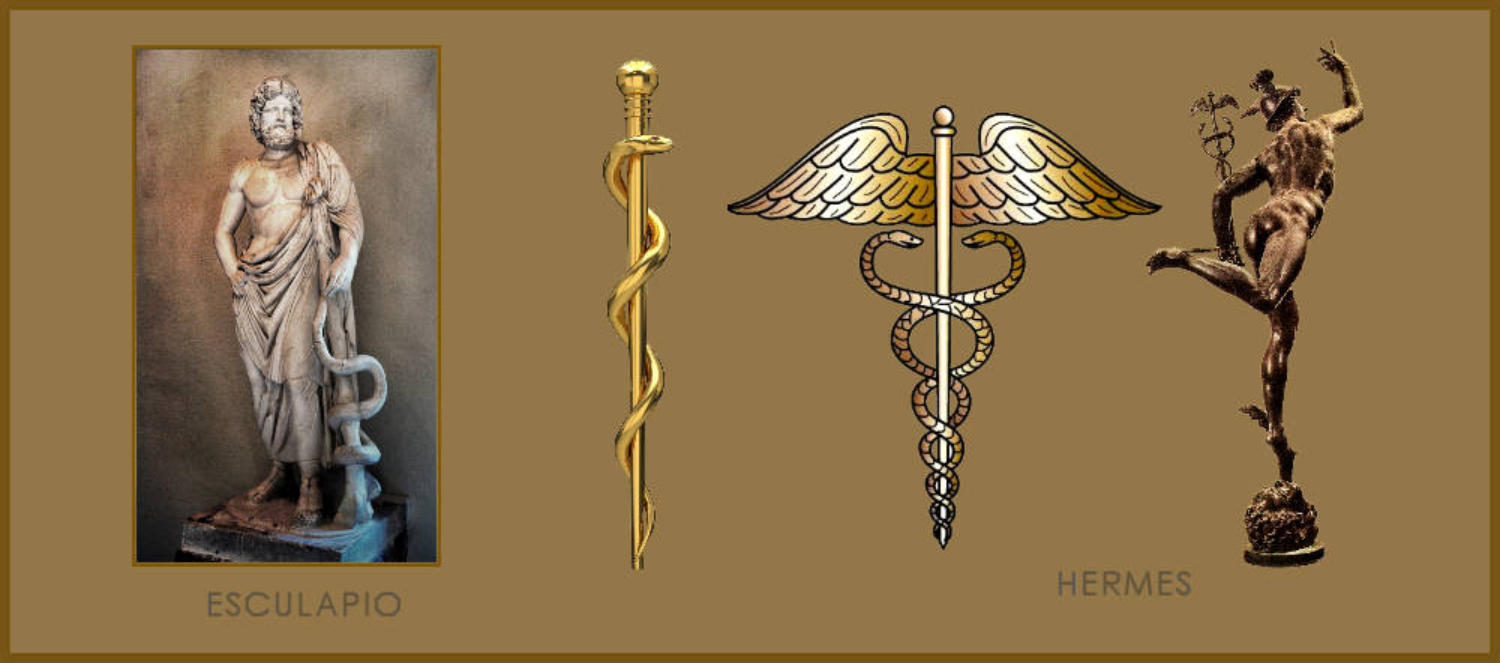
Caduceus
from
the
Greek
karykeion
is
a
wand,
on
top
of
it,
it
has
two
wings
or
a
winged
helmet,
surrounding
the
wand
two
intertwined
snakes
looking at himself in front of the oven.
In
Greek
mythology
the
god
Hermes
(Mercury
for
the
Romans)
was
one
pastoral
god
to
whom
the
invention
of
the
lyre
is
attributed,
Apollo
after
hearing
him
playing
the
lyre,
was
so
dazzled
that
Hermes
gave
it
to
him.
In
compensation,
Apollo
gifted
him
with
a
wand
known
by
the
name
of
karykeion
(caduceus),
who
had
the
power
to
bestow
prosperity.
Later,
after
it
was
named
the
messenger
of
the
gods,
Zeus
also
gifted
him
with
a
helmet
and
some
sandals
with
wings,
authorizing
him
the
power
to
move
over
the
three
worlds,
Olympus,
Earth,
and
the
realm
of
the
dead
or
Hades.
On
one
of
his
travels
Mercury
found
two
snakes
fighting,
he
put
the
wand
in
the
middle
of
them
to
separate
them
and
they
intersected
standing
facing
each
other,
Mercury
left
them
as
a
symbol
of
peace
and
harmony.
The
Romans
used
the
winged
caduceus
of
Mercury
as
a
symbol
of
trade,
and
its
ambassadors
wore
it
as
a
sign
of
peace,
replacing
the
snakes
for
two ribbons.
Completely
different
is
the
rod
of
Asklepios
(Piarist
for
the
Romans)
non-
Olympic
character,
who
lived
in
Thessaly,
notable
doctor
who
enjoyed
a
great
fame.
Piarist
had
three
children,
all
doctors,
and
four
daughters
also
engaged
in
healing,
they
were
Higia
from
which
the
word
is
derived
hygiene,
Panaqueia
(panacea
that
cures
everything),
Egle
the
midwife,
and Laso the Nurse.
The
temples
dedicated
to
Piarist,
were
called
Asclepions,
and
were
the
equivalent
of
hospitals.
The
beds
for
the
sick
were
called
clines,
whence
the
word
clinical
is
derived,
and
the
servants
of
the
temple
were
called
Therapists.
After
his
death,
Piarist
was
deified,
and
he
is
represented
as
a
mature
man
wearing
a
cloak
that
shows
his
right
arm
and
half
bust,
as
an
attribute
carries
a
crosier
with
a
snake
that
surrounds
it,
that
symbolizes
the life and the death, by the poison and healing ointment.
The
crosier
of
Aesculapius
is
used
as
a
symbol
of
medicine,
and
the
caduceus
of
Mercury
as
a
symbol
of
trade
and
development,
though
once
the
doctor
of
Henry
VII
of
England
put
it
on
his
coat
of
arms
and
that
result
to
successive
errors
such
as
that
of
the
US
health
service
in
1856
adopting the symbol as a distinctive.







































































RVM
THE CADUCEUS OF HERMES AND THE ROD OF ASCLEPIUS