
In
Christian
temples,
and
especially
in
the
oldest
ones,
but
also
in
some
more
modern
ones,
they
are
a
clear
example
of
the
symbolism
and
iconography
of
the
so-called
“Sacred
Art.”
Today,
and
not
without
some
concern,
we
see
how
most
newly
built
Christian
temples
are
designed
so
that
the
personality
the
architect
wants
to
give
to
the
work
is
placed
in
the
background
or
sometimes
completely
absent,
this
“Sacred
Art,”
which
should always be above architectural creations.
A
church
should
not
be
a
merely
functional
place
to
accommodate
a
certain
number
of
people.
Its
purpose
is
to
be
a
Temple,
with
an
atmosphere
that
enables
the
faithful
to
elevate
their
consciousness
and
to
have
a
deeper
communion
with
God.
We
do
not
dismiss
the
images,
far
too
frequently,
with
attitudes
of
suffering
or
mystical
introspection,
but
symbolic
imagery
is
also
necessary,
which,
together
with
the
liturgy,
fosters
a
harmonious
combination that leads the faithful toward contemplation and reflection.
This
is
the
case
of
the
Glories
and
Presences,
an
iconography
that
is
still
observed
today
in
some
churches.
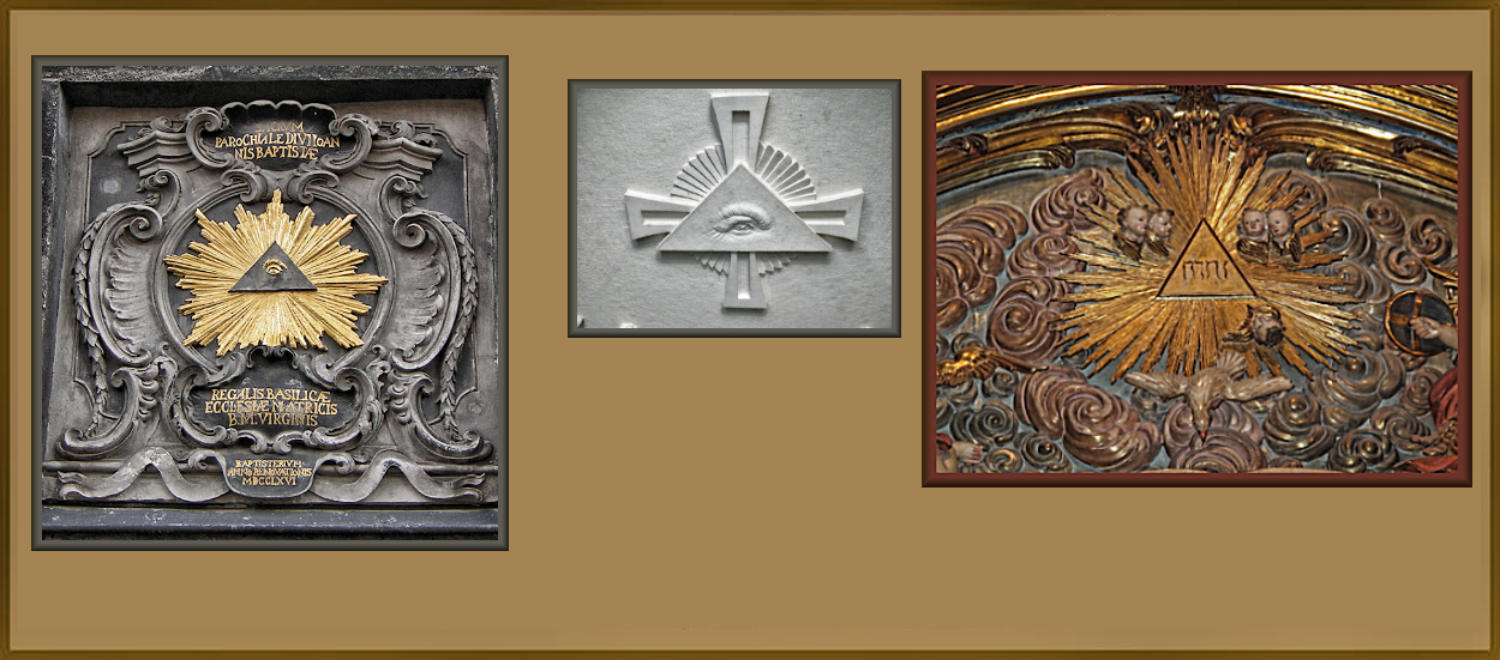
The
Glories
are
a
radiant
triangle
or
delta
that
contains
the
name
of
Yahweh
in
Hebrew
letters.
One
of
the
most
representative
cases
is
found
in
Catalonia
(Spain),
in
the
town
of
Sant
Llorenç
de
Morunys,
in
its
ancient
monastery
dating
from
the
10th
century,
where
the
Baroque
altar
dedicated
to
the
Virgen
dels
Colls
of
the
18th
century, the work of Josep Pujol, is one of the jewels of Catalan Baroque.
The
Presences
are
also
represented
by
a
delta,
sometimes
a
radiant
triangle,
where
inside
there
is
an
eye,
representing
God’s
Omniscient
vision.
Let
us
recall
Psalm
33:18.
“Behold,
the
eye
of
Yahweh
is
upon
those
who fear Him, upon those who hope for His mercy.”






































































GLORYS AND PRESENCES

RVM