

The
eagle
has
always
been
considered
the
most
powerful
and
majestic
bird
in
the
sky,
due
to
the
height
of
its
flight
and,
according
to
Aristotle,
its
ability
to
take
off
facing
the
sun.
Present
in
Egyptian,
Hittite,
Sumerian
and
Babylonian
cultures,
the
Grecians
associated
it
with
the
Divinity,
representing
it
accompanied
by
Zeus-Jupiter,
and
with
rays
trapped
in
its
talons.
The
Roman
legions
carried
it
on
their
banners
from
104
B.C.,
later
Charlemagne
adopted
the
eagle
as
the
symbol
of
the
Roman
Empire;
in
the
emblem
the
eagle
was
black
on
a
golden
background,
it
was
also
the
symbol
of
the
Roman
"Res
Publica".
In
Germanic
mythology
it
was
associated with Odin.
In
the
Middle
Ages
it
was
depicted
in
a
very
stylised
form
on
coats
of
arms
and
heraldic
emblems,
looking
to
the
right
(in
heraldry,
a
view
to
the
right
is
a
symbol
of
legitimacy).
It
has
frequently
been
placed
on
the
top
of
buildings,
on
columns
and
on
obelisks
as
a
symbol
of
majesty,
of
empire, or alluding to its capabilities.
Never
has
an
icon
such
as
the
eagle
been
so
aptly
represented
as
an
emblem
of
imperial
majesty
and
power,
and
like
all
symbols
it
also
has
a
dark
aspect,
the
perversion
of
this
power,
a
predatory
and
cruel
bird,
with
the capacity to oppress and dominate all that is inferior to it.
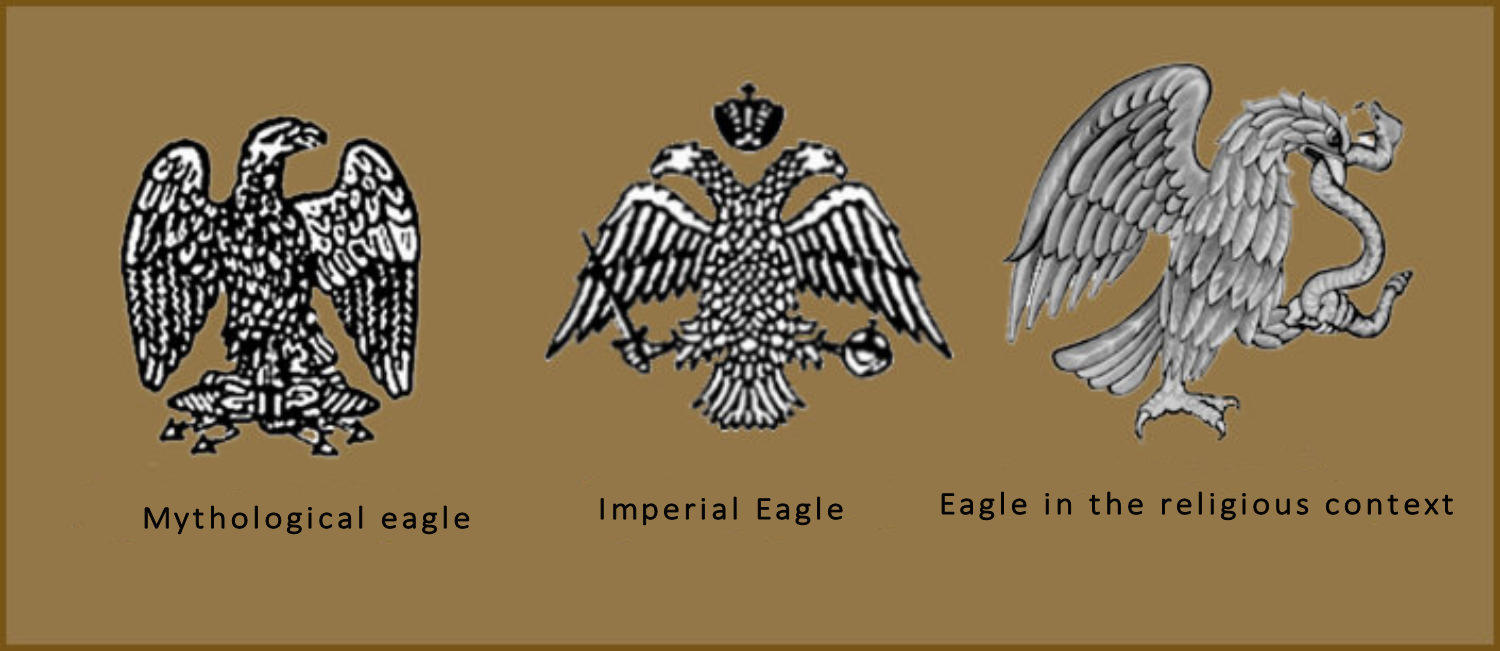
In
Christian
iconography,
as
a
bird
that
kills
snakes,
it
summarises
the
victory
of
light
over
the
powers
of
darkness.
In
the
Tetramorphous
the
eagle
corresponds
to
Saint
John
the
Evangelist,
and
in
the
Bible,
it
is
the
emblem
of
the
Omnipotence
of
God
and
the
power
of
faith,
also
representing
Christians,
who,
baptised
in
Christ,
have
died,
and
risen
with
Him.
Among
the
deadly
sins
it
represents
pride.
In
alchemy
its
meaning
does
not
substantially
change
the
above,
and
it
is
the
symbol
of
sublimation.
An
eagle
devouring
a
lion
symbolises
the
triumph
of
the
spirit
and
the
volatilisation
of
matter.
The
two-headed
eagle
is
attributed
a
Mesopotamian
origin,
its
oldest
representation
is
found
on
a
seal
from
Lagash,
III
millennium
B.C.,
where
under
its
claws
it
has
two
lions.
From
Hittite
art
it
reached
the
West,
by
the
hand
of
Byzantium,
where
it
was
associated with the Roman deity Janus.
During
the
Crusades
it
reached
Eastern
Europe,
where
the
Russian
Empire
took
it
as
its
emblem,
but
it
was
King
Frederick
II
who
established
it
as
the
symbol
of
the
Empire
in
the
West,
and
by
analogy
of
the
two-headed
lion
in
the
Austro-Hungarian
Empire.
In
philosophical
symbolism,
it
is
usually
represented
with
two
tones,
white
and
red,
or
black
and
white,
colours
of
great
symbolic
significance
that
represent
the
dualism
of
creation.
THE EAGLE







































































RVM