
In
the
previous
section
on
Superstitions
(1),
the
nature
of
these
beliefs
and
their
effect
on
superstitious
people
were
described.
Due
to
their
great
influence
that
remains
today,
it
seems
interesting
to
include
some
of
the
most
widespread.
Although
current
thinking
and
knowledge
lead
us
not
to
pay
attention,
we
must
consider
that
they
have
been
present
in
our
unconscious
for
many
centuries,
and
with
a
little
depth
you
would
find
that,
one
way
or
another,
not
all
of
us
are
completely
free
of
them,
since
many
hide themselves as traditions.
Here we will see some of the most significant:
•
Rice,
when
thrown
over
newlyweds
to
wish
them
prosperity
and
abundance.
•
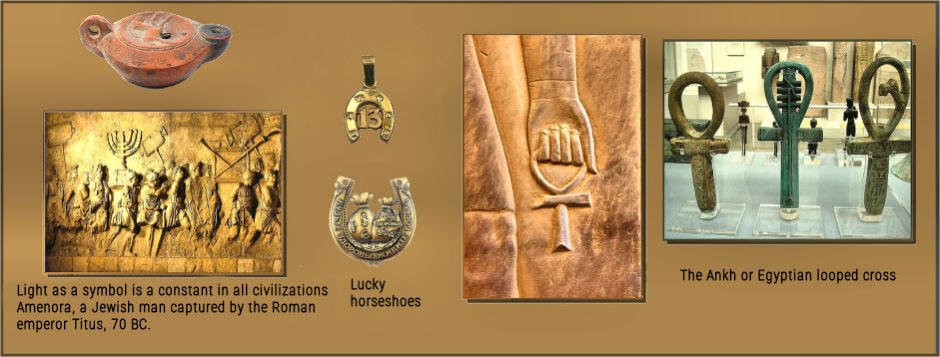
The
Ankh
hooked
cross
(from
Latin,
cross
with
handle,
also
called
the
Egyptian cross), a symbol that many use to seek longevity and wisdom.
•
The
Cruz
de
Caravaca,
originating
from
Caravaca
de
la
Cruz
(Murcia)
in
the
Vera
Cruz
sanctuary,
amulet
in
the
shape
of
a
four-armed
patriarchal
cross
with
origins
between
1230-1250,
when
the
town
was
under
Muslim
rule
and
Muley
Abuceil
converted
to
Christianity;
attributed
powers
against
danger, adversities, and illnesses.
•
Crossing
the
index
and
middle
fingers
while
the
others
stay
hidden
under
the
thumb;
a
gesture
of
protection
against
evil
spirits
and
when
telling a lie to negate its consequences.
•
Spitting;
since
ancient
times
it
has
been
one
of
the
most
effective
gestures
against
all
kinds
of
curses
and
was
considered
very
useful
to
conjure away bad luck.
•
The
horseshoe,
which
has
nothing
to
do
with
the
one
used
for
shoeing
horses;
it
originated
in
ancient
Greece
and
was
introduced
into
Europe
by
the
Romans.
The
Greeks
considered
it
a
sign
of
good
luck
because
of
the
iron
it
is
made
from;
in
Greece
all
iron
charms
were
used
to
ward
off
evil.
The
shape
was
more
like
a
flipped
or
inverted
U
and,
by
anatomical
association, used as a fertility symbol.
•
The
light
of
a
candle
or
a
crucible
burning
at
a
point
in
the
house
is
a
symbol of light within the darkness and wards off all bad vibrations.







































































RVM
SUPERSTITIONS (2)