

The
laurel
and
the
olive
tree,
evergreen,
and
Mediterranean
trees
par
excellence must necessarily be linked to mythology and symbolism.
The
god
Apollo
insistently
sought
the
goddess
Daphne,
and
in
her
flight,
by
the
river
Peneu
she
asked
for
help
from
mother
earth
and
her
father
the
god
of
the
river
who
immediately
transformed
her
into
a
laurel
(called
daphne
by
the
Greeks),
Apollo
kept
the
laurel
in
his
hands
declaring
that
this
tree
would
be
dedicated
to
his
cult,
forests
of
laurels
surrounded
the
sanctuaries
dedicated
to
Apollo;
At
Delphi
the
priestess
Pythia
chewed
laurel
leaves
before
pronouncing
her
oracle;
in
time
the
laurel
was
attributed
powers
of
healing,
purification
and
longevity;
the
goddess
Nike
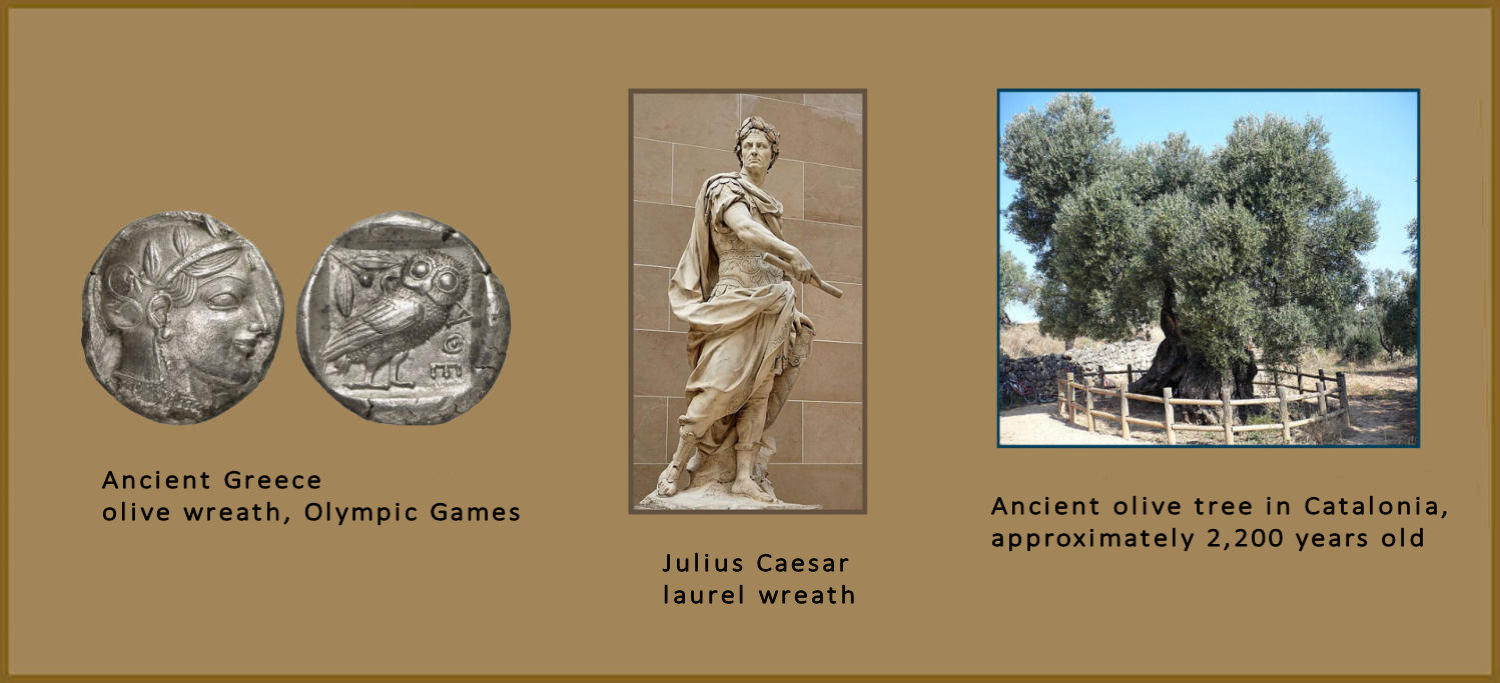
placed laurel wreaths on the heads of the winners of the Olympian games.
Like
the
laurel,
the
olive
tree
was
also
offered
to
the
victors,
often
the
wreaths
were
a
combination
of
both.
Originally
in
a
dispute
over
Attica
between Poseidon and Athena (called Minerva by the Romans),
Athena
caused
an
olive
tree
with
fruit
to
sprout
from
the
ground
and
taught
the
Greeks
how
to
make
oil;
they
gratefully
consecrated
Attica
to
Athena,
naming their capital Athens.
The
olive
tree
became
a
sacred
tree,
and
the
oil
was
used
in
religious
ceremonies,
feeding
the
lanterns
and
crucibles
of
the
temples,
the
flame
of
the
Olympic
games,
and
the
torch
carried
in
the
hand
of
the
goddess
Athena,
oil
became
an
emblem
of
purification
and
life
force,
and
the
olive
tree a symbol of peace and reconciliation.
These
myths
reached
Imperial
Rome,
where
crowns
were
offered
to
victorious
generals
on
their
return
from
conquests,
traditions
that
have
survived
to
the
present
day.
In
Granada
in
1889
the
poet
Zorrilla
was
crowned with a golden laurel wreath.
In
Renaissance
paintings,
whenever
they
wanted
to
represent
a
personage
who
enjoyed
fame,
he
or
she
was
depicted
more
or
less
disguisedly
next
to
a
laurel.
In
Christianity,
the
laurel
was
used
to
welcome
Jesus
in
Galilee,
and
also
as
a
symbol
of
victory
and
immortality
and
as
an
attribute
for
martyrs.
The
church
uses
the
olive
tree
as
a
symbol
of
peace
and
fruitfulness
and
since
Noah's
ark
as
a
symbol
of
reconciliation
with
God.
Oil
is
used
for
anointing;
the
word
Messiah
in
Hebrew
means
the
anointed
one.
A
mixture
of
oil
and
aromatic
herbs
used
for
baptisms,
confirmations
and
ordination
of
priests
is
called
chrism.
In
secular
myths
and
beliefs,
the
laurel
is
the
protective
and
purifying
plant
par
excellence,
it
protects those who live nearby.
As
protection,
a
few
blessed
leaves
are
carried
in
the
pocket
on
Palm
Sunday,
and
a
few
leaves
burned
in
the
house
undo
spells
and
remove
unwanted vibrations.






































































THE LAUREL AND THE OLIVE

RVM